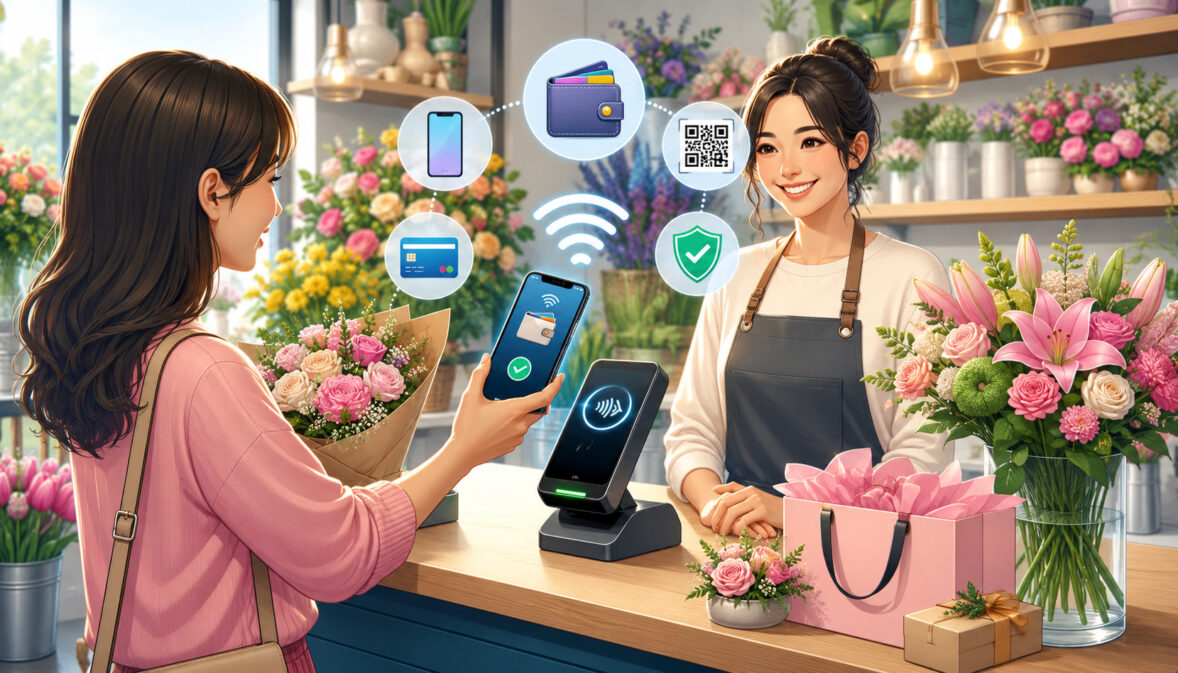
Mobile wallet payments for flower shops are becoming an important part of how floral businesses serve modern customers.
Whether someone is buying a birthday bouquet at the counter, ordering sympathy flowers from a phone, paying a wedding deposit, adding a gift basket to a delivery order, or shopping at a seasonal flower stand, customers increasingly expect checkout to be fast, secure, and flexible.
For flower shops, payments are not limited to one setting. A florist may take walk-in payments, online orders, phone orders, delivery payments, curbside pickup payments, event deposits, subscription payments, and last-minute custom order balances.
Mobile wallet payments help connect these different sales channels by giving customers a convenient way to pay with a smartphone, smartwatch, or compatible digital wallet.
Mobile wallet payments can also support a cleaner and more professional customer experience. Customers can tap a phone at the counter, pay through a mobile-friendly checkout page, approve a payment link from a text message, or complete payment before a delivery leaves the shop.
When set up responsibly, this can reduce checkout friction, speed up busy periods, improve receipt tracking, and support better reporting for the business.
For florists, the goal is not to replace every other payment method. Cash, cards, invoices, ACH payments, phone payments, and online checkout still matter. The real value of mobile wallet payments for flower shops is payment flexibility. Florists can serve more customer preferences while keeping security, documentation, and reconciliation organized.
What Are Mobile Wallet Payments for Flower Shops?
Mobile wallet payments for flower shops are payments made through a smartphone, smartwatch, tablet, or other compatible device using a digital wallet.
A customer stores a payment card or account in a wallet app, then uses that device to approve the transaction. The payment may happen at a contactless terminal, through an online checkout page, by payment link, through a mobile POS tool, or during delivery with a compatible reader.
For a flower shop, mobile wallet payments can appear in several daily situations. A walk-in customer may tap a phone on a countertop terminal for a wrapped bouquet. A delivery customer may pay through a secure link before the driver arrives.
A wedding client may pay a deposit from a digital invoice. A pop-up floral seller may accept tap-to-pay at an event booth using a mobile device and portable reader.
The most common mobile payment options for florists include smartphone wallets, smartwatch payments, NFC payments, contactless cards, QR code payments, online wallet checkout, payment links, and mobile POS payments.
Some customers may recognize wallet names such as Apple Pay, Google Pay, or Samsung Pay, while others simply think of the process as tapping a phone or paying from a mobile checkout screen.
The key idea is convenience with security. Instead of handing over cash, reading card numbers by phone, or waiting for a keyed transaction, the customer can approve payment quickly from a device they already use every day.
For flower shops handling emotional, time-sensitive, and seasonal purchases, that speed can make the checkout process feel smoother.
How Mobile Wallet Payments Work
Mobile wallet payments usually begin when a customer adds a payment card or eligible account to a digital wallet on a phone, watch, or compatible device. When it is time to pay, the customer confirms the transaction using device security, such as biometric authentication, a passcode, or another approval method.
At the counter, the customer may hold the device near a contactless terminal. Online, the customer may select a wallet option during checkout and approve the purchase from the device.
Behind the scenes, mobile wallet transactions often use tokenization. Tokenization helps protect sensitive payment details by replacing the original card number with a unique digital token during the transaction. This means the flower shop does not need to directly handle or store the customer’s full card number for that wallet payment.
The payment is then routed through the payment terminal, payment gateway, processor, card network, issuing bank, and merchant account systems. The transaction may be approved or declined based on available funds, security checks, authorization rules, and payment risk signals.
For florists, this process feels simple at the front end: the customer taps, approves, and receives confirmation. Still, the business should understand that mobile wallet payments require compatible hardware, secure software, reliable internet or cellular connectivity, and clear reporting so sales can be reconciled at the end of the day.
Why Florists Are Adding Mobile Wallet Options
Florists serve customers in more varied environments than many traditional retailers. A single flower shop may handle retail counter sales, online orders, phone orders, delivery payments, wedding deposits, sympathy flower orders, corporate accounts, pop-up markets, and holiday rushes.
Because customers pay in different ways across these settings, mobile wallet payments give florists more flexibility.
Customers often choose mobile wallet payments because they are fast and familiar. Many people keep their phones nearby but may not carry cash. Others prefer contactless checkout because it feels cleaner, quicker, and easier than inserting a card or signing a receipt. For busy flower shops, every saved moment can help during peak order windows.
Flower shop mobile payments also support customers who are not physically in the store. A customer ordering flowers for a recipient across town may pay through online checkout or a payment link. A wedding client may pay an invoice from a mobile device. A delivery customer may approve payment before the order leaves the shop.
For florists, the benefit is operational as well as customer-facing. Mobile wallet payments can connect to POS reports, order records, digital receipts, delivery confirmations, and refund workflows. That helps the business maintain better payment documentation while giving customers more convenient choices.
Benefits of Mobile Wallet Payments for Flower Shops
The benefits of mobile wallet payments for flower shops go beyond the ability to accept a newer payment type. When used well, mobile wallet payments can improve checkout speed, reduce friction, support contactless payments, create clearer records, and help customers complete purchases in the moment.
Flower purchases are often time-sensitive. A customer may need sympathy flowers delivered quickly, a last-minute birthday arrangement, a corsage before an event, or a gift basket added to a same-day delivery. Any payment delay can interrupt the order flow. Mobile wallet payments help reduce those interruptions by making the approval step faster and more familiar.
Digital wallet payments for florists can also support a more professional payment experience. Instead of writing down card details, sending unclear totals, or relying only on phone payments, florists can send secure payment links, accept tap-to-pay, generate digital receipts, and keep sales records connected to the customer order. This is especially useful for custom orders, event deposits, and delivery payments.
Another benefit is customer confidence. A clear checkout total, quick payment confirmation, and digital receipt can make customers feel more comfortable. That matters in floral sales because customers are often buying for meaningful occasions. A smooth payment process lets them focus on the message, arrangement, delivery timing, and recipient experience.
For businesses reviewing broader flower shop payment processing, mobile wallets should be evaluated as part of the full payment mix, not as a standalone feature.
Faster Checkout During Busy Floral Seasons
Busy floral seasons can put pressure on every part of a shop’s workflow. During holiday rushes, wedding season, prom periods, graduation orders, sympathy order spikes, and same-day delivery windows, checkout speed matters.
A long line at the counter can frustrate customers and slow staff who are already balancing design, phones, delivery coordination, and order updates.
Mobile wallet payments can help reduce checkout time because customers do not need to search for cash, insert a card, or wait through a slower process when tap-to-pay is available. A customer can approve payment with a phone or watch and move on quickly.
This is useful for smaller purchases such as single bouquets, greeting cards, vases, balloons, chocolates, plants, and gift add-ons.
Faster checkout also helps seasonal staff. During peak periods, flower shops may rely on temporary or part-time help. A clear mobile wallet process can be easier to teach than several manual payment workflows. Staff can confirm the total, invite the customer to tap, check approval, and send a receipt.
More Convenient Payment Options for Customers
Customers value convenience, especially when they are placing emotional or urgent flower orders. Some customers may be ordering from work, from a hospital parking lot, from an event venue, or while traveling. Others may be standing at the counter with limited time. Mobile wallet payments allow customers to pay using the device already in their hand.
Mobile payment options for florists can support both planned and last-minute purchases. A customer planning a wedding consultation may pay a deposit through a digital invoice. Someone ordering sympathy flowers may complete online payment from a phone. A walk-in customer may use a smartwatch to buy a bouquet without needing a physical wallet.
Convenience also supports higher order completion. When checkout is complicated, customers may delay payment, ask to call back, or abandon an online cart. A mobile-friendly payment option can help reduce that friction. This is especially important for flower delivery payment processing, where the customer may not be physically present.
For florists, convenience should still be paired with clear communication. Customers should know which payment methods are accepted, whether payment is required before delivery, how deposits work, and when receipts are sent. Convenience works best when the customer understands the process.
Common Mobile Wallet Payment Options Florists Can Accept
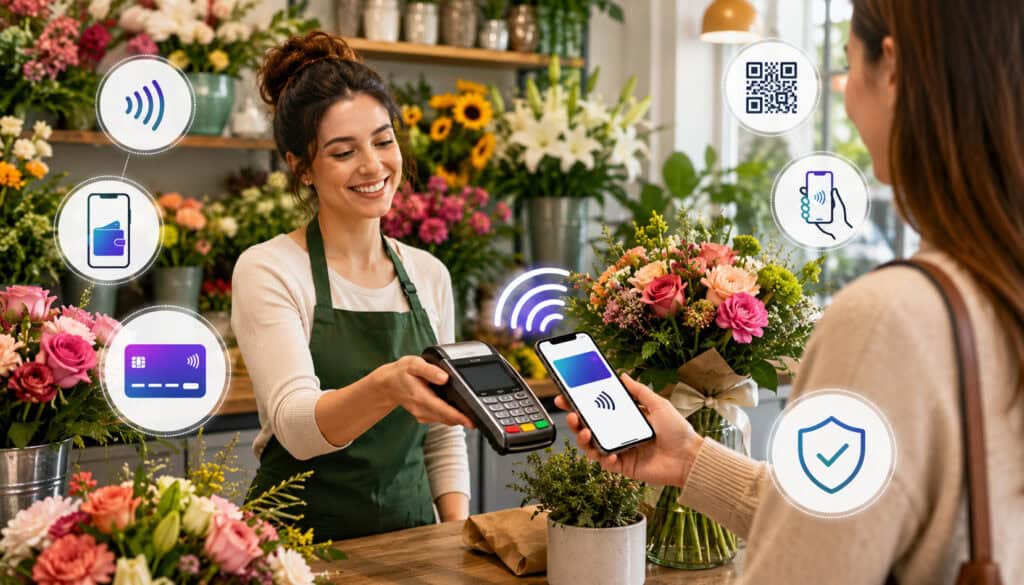
Florists can accept mobile wallet payments in several ways depending on their sales channels. The most familiar option is a contactless terminal at the checkout counter. Customers tap a smartphone, smartwatch, or contactless card to complete payment. This is useful for retail purchases, pickup orders, and quick add-ons.
Mobile POS tools are another option. These can include handheld terminals, tablet POS systems, mobile card readers, or compatible devices that accept contactless payments. For event florists, pop-up sellers, delivery teams, and seasonal floral sellers, mobile POS tools can make it easier to collect payment outside the main shop.
Online payments for florists can also include mobile wallet options. A flower shop website may allow customers to choose a digital wallet at checkout. This can make mobile ordering easier, especially when customers do not want to type card details into a small screen. Payment links and digital invoices can also support wallet-based payment from a phone.
QR code payments may be useful in certain settings, such as event booths, pickup counters, or printed invoices. A customer scans the code, reviews the payment page, and completes the transaction. The florist should ensure the QR code points to a secure, legitimate payment page and that staff can confirm payment before releasing an order.
Tap-to-Pay and NFC Payments
Tap-to-pay and NFC payments allow a customer to hold a compatible phone, watch, or contactless card near a payment terminal. NFC stands for near-field communication, which allows the device and terminal to communicate over a very short range. For flower shops, this is one of the most practical forms of contactless checkout.
Tap-to-pay works well for in-store purchases because it is quick and simple. A customer chooses flowers, the staff rings up the sale, and the customer taps the device when prompted. This can be especially helpful for add-on items, such as candles, cards, small plants, wrapped stems, balloons, and gift baskets.
NFC payments are also useful beyond the retail counter. Florists selling at flower markets, outdoor events, wedding venues, school fundraisers, or seasonal pop-ups can use portable contactless tools to accept payments on the go. Curbside pickup can also benefit when a staff member has a handheld payment device ready.
Online and Delivery Wallet Payments
Mobile wallet payments are not limited to in-person checkout. Many customers order flowers from a phone, especially for delivery. Online wallet checkout can help customers complete the order faster because they may not need to type full card details, billing information, or shipping information if the wallet supports saved credentials.
Payment links are another practical option. A florist may prepare a custom quote for funeral flowers, wedding centerpieces, event arrangements, or a corporate gift order. Instead of taking card details over the phone, the shop can send a secure payment link by text or email. The customer opens the link, reviews the amount, and completes payment from a mobile device.
Digital invoices can work similarly for larger balances. A wedding florist may send an invoice for a deposit, progress payment, or final balance. A business account may receive an invoice for weekly lobby flowers or recurring gift arrangements. If the invoice supports mobile wallet payments, the customer can pay without calling the shop.
For delivery payments, florists may choose between collecting payment before delivery or accepting payment when the customer is present. Prepayment is often cleaner for routing and delivery scheduling. Pay-at-delivery can be useful in some cases, but it requires secure devices, staff training, and clear confirmation before the order is considered paid.
Mobile Wallet Payments vs Other Flower Shop Payment Methods
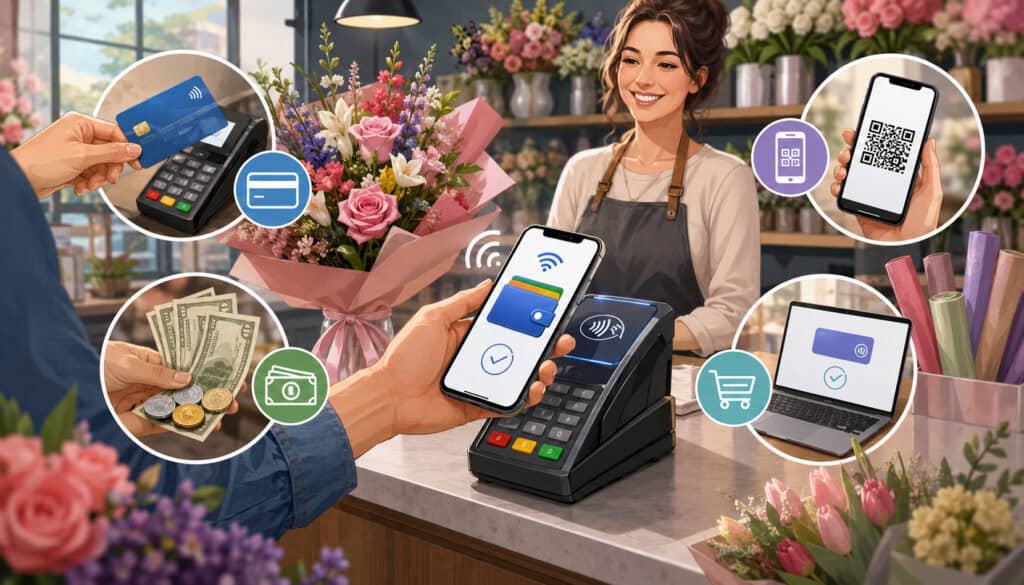
Mobile wallet payments are useful, but they are only one part of a complete florist payment processing strategy. Flower shops often need a mix of payment options because customers buy flowers in many different ways. A walk-in bouquet, a corporate invoice, a wedding deposit, a phone order, and a website delivery order may each require a different workflow.
Cash can still be useful for small in-store purchases, but it is harder to track and reconcile. Credit and debit cards remain familiar and widely used, but keyed and online transactions may carry different risk and pricing considerations.
ACH payments can be helpful for larger invoices or recurring accounts, but they may require authorization and can take longer to settle. Payment links and invoices are valuable for custom orders and remote customers.
Mobile wallet payments stand out because they are flexible across multiple channels. They can support in-store tap-to-pay, online checkout, payment links, mobile POS payments, and some delivery workflows. Still, florists should evaluate costs, security, reporting, refund handling, and customer expectations before relying on one method too heavily.
| Payment Method | Best For | Benefits | Things to Review |
| Mobile wallets | Fast in-store, online, and delivery payments | Convenient, contactless, mobile-friendly | Requires compatible tools |
| Credit/debit cards | Most flower shop purchases | Familiar and widely used | Processing fees and declines |
| Cash | Small in-store purchases | Simple for some customers | Harder to track and reconcile |
| ACH payments | Larger invoices or recurring accounts | Useful for some business payments | Authorization and timing |
| Payment links | Custom orders and remote payments | Easy to send by text or email | Link security and confirmation |
| Phone payments | Last-minute or custom orders | Helpful for remote customers | Higher risk if keyed manually |
| Online checkout | Website flower orders | Smooth ordering experience | Delivery zones and clear pricing |
| Invoices | Weddings, events, and corporate accounts | Useful for larger balances | Follow-up and payment terms |
When Mobile Wallets Are the Best Fit
Mobile wallets are often the best fit when speed, convenience, and customer presence matter. Quick retail purchases are a strong example. A customer buying a bouquet, card, vase, or small gift can tap a device and leave with a receipt in seconds. This helps the shop keep lines moving and gives customers a modern checkout experience.
Mobile wallets also fit pickup orders. A customer may place an order online, then pay at the counter or curbside. If the total changes because of add-ons or substitutions, staff can process the final amount through a contactless reader. The customer can approve the transaction quickly without handing over a card.
For pop-up flower stands, markets, and event sales, mobile wallets can help florists accept payments without a full register setup. A portable device or mobile POS can support contactless checkout in temporary selling environments.
They are also useful for gift add-ons and small upgrades. Customers may decide at the last moment to add chocolates, balloons, candles, plush gifts, or a premium vase. A fast payment option makes these changes easier to complete.
When Other Payment Methods Still Matter
Other payment methods remain important because floral businesses handle many transaction types that are not always simple retail sales. Wedding orders, corporate accounts, sympathy arrangements, subscription flowers, and large event balances may require invoices, deposits, partial payments, ACH options, or scheduled billing.
Phone payments may still be needed when a customer is not comfortable using online checkout or payment links. However, florists should treat manually keyed phone payments carefully because they may carry more fraud and dispute risk than card-present payments. Clear authorization, order notes, delivery records, and receipt confirmation can help reduce confusion.
Traditional card payments also remain essential. Not every customer uses a mobile wallet, and some customers prefer physical cards. A flower shop should avoid creating a payment setup that excludes customers who are more comfortable with familiar methods.
Invoices are especially useful for event florists. A wedding client may need a proposal, deposit schedule, balance reminders, and documented payment terms. In these cases, mobile wallet payments can support the invoice, but the invoice workflow remains the main structure.
Mobile Wallet Payments for In-Store Flower Shop Checkout
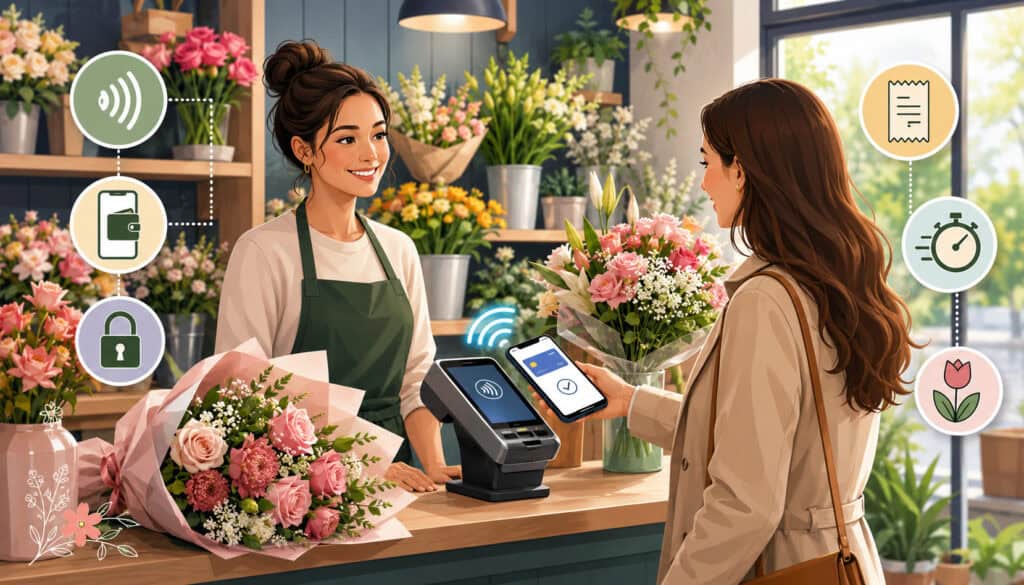
In-store checkout is where many florists first see the value of mobile wallet payments. A contactless-enabled payment terminal at the counter can make checkout faster, especially when customers are buying ready-made bouquets, plants, greeting cards, or gift items. Instead of handling cash or waiting for chip-card processing, customers can tap and confirm.
In-store mobile wallet payments also support a cleaner customer flow. The staff member can ring up the sale, confirm the total, offer a digital receipt, and move to the next customer. During busy periods, this can reduce lines and help staff focus on order accuracy.
Florist checkout payments are often connected to more than one product type. A single sale might include flowers, a vase, a delivery fee, a greeting card, a service fee, and a tip. A POS system that connects mobile wallet payment acceptance with itemized receipts can help the customer understand the total.
For shops reviewing florist POS payment processing, the payment device should work with sales tracking, inventory, customer records, and reporting. A fast payment is helpful, but a fast payment with accurate records is much more valuable.
Reducing Lines and Checkout Friction
Checkout friction happens when the payment process slows down the customer or distracts staff from order accuracy. In a flower shop, this can occur during holiday rushes, lunch-hour walk-ins, weekend pickup windows, and closing-time last-minute orders. Mobile wallet payments help by reducing the number of steps at checkout.
A customer does not need to count cash, search for a card, wait for manual entry, or sign a paper slip in many typical tap-to-pay transactions. The device prompts approval, the customer taps, and the POS confirms the result. This can make small purchases feel much easier.
Reducing friction also helps with emotional purchases. Someone buying sympathy flowers may not want a long checkout conversation. Someone buying anniversary flowers may be in a hurry. A quick, respectful checkout experience supports the customer’s reason for buying.
Connecting Mobile Wallets With Florist POS Systems
POS integration matters because payment acceptance is only one part of the transaction. A florist also needs to track what was sold, who bought it, where it should go, how it was paid, whether a receipt was issued, and whether a refund or adjustment is later needed.
When mobile wallet payments connect to a florist POS system, the business can keep sales records organized. This helps with inventory counts, delivery notes, daily batch reports, staff accountability, customer history, and reconciliation. If the shop sells a bouquet, vase, card, and delivery service in one sale, the POS should record each part clearly.
Integration is also helpful for refunds. If a customer cancels a pickup order, receives the wrong arrangement, or needs an adjustment, staff should be able to find the original sale and process a refund according to policy. Good records reduce confusion and help prevent unnecessary disputes.
For flower shops with online and in-store sales, POS integration can reduce double entry. Orders, payments, receipts, and inventory updates should flow through the same system whenever possible.
Mobile Wallet Payments for Flower Delivery and Curbside Pickup
Flower delivery payment processing requires careful planning because the payer, recipient, delivery address, and order contact may be different people. A customer may order flowers for someone else, pay remotely, and request delivery at a specific time. In other cases, the recipient or customer may pay at pickup or delivery.
Mobile wallet payments can support these workflows in several ways. A customer can pay online before the arrangement is prepared. A florist can send a payment link after confirming a custom quote.
A delivery team can use a mobile reader when payment is collected in person. A curbside pickup order can be paid from the customer’s phone before staff brings the flowers outside.
Delivery payments should be designed to reduce confusion. The shop should clearly state whether payment is due before delivery, whether tips can be added, how delivery fees appear on receipts, and what happens if the customer is not present. Digital receipts can help document payment status.
For custom arrangements, payment links can be especially helpful. A florist may discuss substitutions, size, color palette, and delivery timing with the customer, then send a final payment link after the quote is approved. This avoids writing down card details and gives the customer a clear payment record.
Accepting Contactless Payments During Delivery
Delivery teams can accept contactless payments when they have compatible mobile devices, handheld terminals, or mobile card readers. This can be useful when payment is collected at the door, at an event venue, or during a local business delivery. The customer can tap a phone, watch, or contactless card, then receive a digital receipt.
Security and training are important. Delivery staff should know how to confirm the amount, handle declines, issue receipts, protect the device, and avoid taking card information manually unless the shop has an approved procedure. Staff should also understand when to call the shop for help instead of improvising.
Mobile devices used for delivery payments should be protected with passcodes, updated software, and limited access. If a device is lost, the business should have a process to revoke access quickly. Payment apps should not be mixed casually with personal apps or shared logins.
Using Payment Links for Remote Flower Orders
Payment links are one of the most practical tools for remote flower orders. A florist can send a secure link by text or email after confirming the order details. The customer opens the link on a phone, reviews the amount, and pays using a supported method, which may include mobile wallet payments depending on the payment page.
Payment links are helpful for last-minute add-ons. A customer may want to upgrade the arrangement, add a balloon, include chocolates, or change the delivery address. Instead of taking card information over the phone, the shop can send a revised payment link and wait for confirmation before fulfilling the change.
They are also useful for custom quotes. Wedding flowers, sympathy sprays, event florals, and corporate arrangements often require pricing after a consultation. A payment link gives the customer a clear amount and helps the florist collect payment before ordering supplies or reserving design time.
Flower shops should use secure links only through trusted payment tools. Staff should avoid sending unclear links, shortening links in suspicious ways, or asking customers to send card numbers through text messages.
Secure Mobile Wallet Payments for Flower Shops
Secure mobile wallet payments for flower shops depend on the right combination of technology, procedures, and staff training. Digital wallets can offer strong security features, but the business still needs to use secure terminals, protect devices, maintain access controls, and follow payment handling best practices.
Mobile wallet transactions often use tokenization and encryption to help protect card data. The PCI Security Standards Council explains that PCI Data Security Standards set technical and operational requirements for organizations that accept or process payment transactions, as well as software and device providers involved in those transactions.
Security also includes fraud prevention. Flower shops can be exposed to payment risk because many orders are remote, urgent, perishable, and delivered to someone other than the buyer. A suspicious rush delivery, mismatched billing details, unusually large order, or repeated failed payment attempt should be reviewed carefully.
For helpful background on payment security expectations, florists can review PCI payment data protection guidance. For consumer-facing scam awareness, the FTC’s guide to mobile payment app scams explains why users should be careful when sending money through mobile payment apps.
Tokenization and Customer Payment Data Protection
Tokenization is one of the most important security concepts behind many mobile wallet payments. Instead of transmitting the customer’s full card number in a way the florist can see or store, the wallet and payment network use a token that represents the payment credential for that transaction or device.
For flower shop owners, the practical benefit is simple: the business should not need to write down or store sensitive card details for a mobile wallet transaction. The approved payment flows through secure payment systems, and the shop receives the authorization result and receipt record.
This does not mean there is no responsibility. Florists still need to use approved payment tools, keep systems updated, restrict staff access, and avoid unsafe workarounds. For example, if a customer’s wallet payment fails, staff should not ask the customer to text a card number. They should use an approved alternate payment method.
Tokenization works best when the entire payment flow is designed properly. Counter terminals, mobile POS tools, online checkout pages, payment links, and digital invoices should all be part of a secure payment environment.
PCI Compliance and Secure Payment Handling
PCI compliance refers to payment security standards for businesses that accept, process, transmit, or store cardholder data. Flower shops should treat compliance as an ongoing business practice, not a one-time form. Even small shops should use secure payment tools and avoid unnecessary exposure to sensitive information.
A practical approach includes using secure terminals, avoiding written card details, limiting staff access, keeping POS software updated, protecting mobile devices, using strong passwords, and following provider instructions for payment security. Staff should understand what they may and may not do with customer payment information.
Secure payment handling also includes refund and dispute procedures. If a customer requests a refund, staff should process it through the approved system and keep proper records. If a payment dispute occurs, the shop should have receipts, order notes, delivery confirmation, and customer communication available.
A shop reviewing fraud risk can also study payment scam prevention for floral businesses to understand how documentation, staff awareness, and secure workflows support safer digital payments.
Flower Shop Mobile Payment Processing Fees
Flower shop mobile payment processing fees can vary based on the payment method, transaction type, processor agreement, hardware, software, and risk profile.
Mobile wallet payments are often processed through card networks when the wallet is connected to a card, so they may be priced similarly to the underlying card transaction. However, in-person wallet payments and online wallet payments may be treated differently.
Florists should review the full cost of accepting mobile wallet payments. This may include transaction fees, monthly account fees, payment gateway fees, mobile reader costs, chargeback fees, refund handling, PCI-related fees, statement fees, batch fees, and other service charges. The advertised rate is only one part of the total cost.
Pricing may differ between card-present and card-not-present payments. A tap-to-pay transaction at the counter may carry different cost and risk than an online wallet checkout or payment link transaction. Phone payments keyed manually may also have different pricing because they usually carry higher risk.
Funding timelines matter as much as fees. Florists often need cash flow for fresh inventory, supplies, rent, payroll, delivery fuel, and event materials. Reviewing deposit timing, batch cutoffs, weekend handling, and holiday delays can help prevent surprises.
Card-Present vs Online Mobile Wallet Transactions
Card-present mobile wallet transactions usually happen when the customer is physically present and taps a device on a compatible terminal. These transactions may be treated differently from online payments because the device and terminal interact directly, and the customer uses device authentication.
Online mobile wallet transactions happen through a website, checkout page, invoice, or payment link. The customer may still approve the payment through a wallet, but the business is processing the order remotely. This may fall into a card-not-present category depending on the payment setup and processor rules.
For florists, this distinction matters because flower delivery orders, custom quotes, and event deposits are often remote. A customer may pay from a phone without entering the shop. These transactions can be convenient, but they should include clear order details, delivery information, customer contact records, and confirmation messages.
Funding Timelines and Deposit Reporting
Funding timelines determine when approved payments reach the business bank account. A florist may accept several mobile wallet payments in one day, but deposits may arrive later depending on batching, cutoff times, weekends, holidays, bank processing, and provider policies.
Deposit reporting should be clear enough to match daily sales with bank deposits. If a shop accepts in-store payments, online orders, delivery payments, and payment links, the owner or manager needs reporting that separates sales by channel, payment type, fees, refunds, and chargebacks.
Refunds and chargebacks can affect deposits. A refund may reduce a future batch or appear as a separate debit. A chargeback may remove funds while the dispute is reviewed. Florists should understand how these events appear in reports so reconciliation does not become confusing.
For seasonal flower shops, funding review is especially important before peak order periods. Higher-than-normal volume can sometimes trigger risk reviews or funding delays if the processor is not familiar with the business pattern. Clear communication and accurate records help reduce operational stress.
Mobile Wallet Payment Checklist for Flower Shops
A checklist can help flower shops decide whether they are ready to accept mobile wallet payments responsibly. The right setup depends on the business model.
A small retail shop may need a countertop terminal and digital receipts. A delivery-focused florist may need payment links and mobile readers. A wedding florist may need invoices, deposits, and partial payment tracking.
Before adding mobile wallet payments, florists should review hardware, software, online checkout, reporting, refund workflows, staff permissions, and customer communication. The goal is to accept convenient payments without creating confusion, security gaps, or reconciliation problems.
| Setup Area | What to Review | Why It Matters |
| Payment terminals | Contactless and NFC support | Enables tap-to-pay checkout |
| POS integration | Sales, inventory, and reporting sync | Improves operations |
| Online checkout | Digital wallet compatibility | Supports mobile shoppers |
| Delivery payments | Mobile reader or payment link options | Helps collect payments on the go |
| Security | Tokenization, PCI, user permissions | Protects customer data |
| Receipts | Email or text receipt options | Improves transparency |
| Refunds | Simple refund workflow | Helps resolve order issues |
| Reporting | Deposits, batches, and sales reports | Supports reconciliation |
| Staff training | Checkout and delivery procedures | Reduces errors |
| Customer communication | Accepted payment method notices | Sets clear expectations |
A checklist should not be completed once and forgotten. Flower shops should revisit payment readiness before major holidays, website updates, POS changes, new delivery policies, event seasons, or staff changes.
Questions to Ask Before Accepting Mobile Wallet Payments
Before accepting mobile wallet payments, florists should ask practical questions about compatibility, cost, security, and operations.
Does the current terminal accept NFC payments? Does the online checkout support digital wallets? Can payment links be sent securely? Can delivery staff accept contactless payments without using personal accounts or unsafe tools?
Cost questions are also important. What are the transaction fees for tap-to-pay, online wallet checkout, payment links, keyed payments, refunds, and chargebacks? Are there monthly gateway fees, equipment fees, PCI-related fees, or batch fees? How quickly are deposits funded?
Operational questions matter as well. Can the POS track wallet payments by order type? Can staff issue digital receipts? Can managers limit employee permissions? Can reports separate in-store, online, delivery, and event payments?
Florists should also ask about support. If a payment terminal fails during a holiday rush, who can help? If a payment link does not work for a customer, what is the backup process? Good payment tools should be supported by reliable procedures.
Documentation Flower Shops Should Maintain
Documentation helps florists manage payments with confidence. A flower shop should keep written payment procedures, staff training notes, refund policies, dispute records, receipts, processor terms, device records, delivery payment notes, and POS reports. Organized documentation helps protect the business from confusion.
Payment procedures should explain how staff accept mobile wallet payments, what to do when a payment is declined, how to send receipts, how to handle refunds, and when to escalate issues to a manager. Delivery payment procedures should be especially clear because staff may be working away from the shop.
Refund records are important because floral products are perishable and sometimes customized. A refund policy should explain cancellations, substitutions, delivery issues, event deposits, and customer complaints. Staff should know how to document each situation.
Dispute records can include order confirmations, receipts, delivery proof, customer messages, photographs where appropriate, and refund notes. For online flower shops, chargeback prevention strategies can help explain why order documentation and clear policies matter.
Best Practices for Mobile Wallet Payments for Flower Shops
Best practices help flower shops accept mobile wallet payments in a way that is convenient for customers and manageable for the business. The payment process should be fast, but it should also be secure, documented, and easy to reconcile.
Useful best practices include:
- Use contactless-enabled payment terminals.
- Make accepted wallet options visible at checkout.
- Support mobile-friendly online checkout.
- Use secure payment links for custom orders.
- Train staff on wallet payment acceptance.
- Send digital receipts automatically.
- Keep refund and cancellation policies clear.
- Protect mobile devices with passcodes.
- Avoid writing down card details.
- Reconcile mobile wallet payments daily.
- Review processing fees regularly.
- Test wallet payments before busy seasons.
- Keep payment software updated.
- Use role-based staff permissions.
- Communicate payment options before delivery.
These practices are especially helpful for florists because the business often operates across multiple settings. A customer may begin an order online, change it by phone, pay through a link, and request delivery. The payment process should support that journey without losing order clarity.
The best approach is to keep payments simple for customers and structured for staff. Customers should see clear totals and receive confirmation. Staff should know exactly which tool to use and how to document the transaction.
Training Staff to Accept Wallet Payments
Staff training is essential because even strong payment tools can create problems when employees are unsure how to use them. Florists should train counter staff, delivery drivers, event staff, seasonal workers, and managers on mobile wallet payment procedures.
Training should cover how to start a wallet payment, confirm the amount, recognize approval or decline messages, send receipts, handle customer questions, and process refunds according to policy. Staff should also know what not to do, such as writing down card numbers, using personal devices without approval, sharing logins, or bypassing security prompts.
Declined payments should be handled calmly. Staff can ask the customer to try another approved method, but they should avoid making assumptions about the reason for the decline. If the customer is remote, the shop can send a new payment link or ask for another approved payment method.
Testing the Customer Payment Experience
Testing helps florists catch problems before customers experience them. A shop should test in-store checkout, online checkout, payment links, delivery payments, receipts, refunds, confirmation messages, and reporting. Testing should happen before busy periods, after software updates, and when new devices are added.
For in-store checkout, test several purchase types: a small bouquet, a bouquet with add-ons, a delivery order, a pickup order, and a discounted item. Confirm that the payment, receipt, and POS record all match.
For online checkout, test the mobile experience from a customer’s perspective. Is the checkout page easy to read on a phone? Are delivery fees clear? Can the customer choose a delivery date? Does the wallet payment option appear correctly? Does the confirmation message include the right order details?
For payment links, test how the link appears in text and email. Make sure the amount, business name, order description, and receipt are clear. For delivery payments, test mobile connectivity and staff permissions before drivers need the tool.
Common Mistakes to Avoid With Digital Wallet Payments for Florists
Digital payments for flower shops can create problems when they are added without planning. The most common mistakes include using outdated terminals, failing to explain accepted payment options, relying on weak staff training, skipping digital receipts, ignoring reconciliation, lacking refund procedures, leaving devices unsecured, and assuming all mobile wallets work the same way.
Another mistake is treating mobile wallet payments as automatically risk-free. While digital wallets can provide strong security features, florists still need good procedures. A rush delivery paid through a suspicious remote transaction still deserves review. A payment link should still be sent securely. A refund should still be documented.
Some shops also forget to connect payments with operations. If the payment is accepted but the order notes, delivery date, substitution policy, or receipt are unclear, the customer experience can still suffer. Payment success should be connected to order success.
Mobile wallet payments work best when they are part of a complete workflow: customer order, clear total, secure payment, receipt, fulfillment, delivery confirmation, and reporting.
Using Outdated Payment Equipment
Older payment terminals may not support contactless payments, NFC payments, mobile wallet payments, or modern security updates. This can frustrate customers who expect to tap a phone or contactless card. It can also slow down staff who must fall back on older payment methods.
Outdated equipment may create compatibility issues with POS systems, receipt tools, reporting, or security requirements. A terminal that works for basic card payments may not be the best fit for mobile checkout for flower shops, especially if the business also needs delivery payments or event sales tools.
Florists should review hardware before peak seasons. Does every register accept contactless payments? Do mobile readers work reliably? Are software updates current? Are receipts printing or sending properly? Are staff permissions configured?
Replacing or updating equipment should be viewed as an operational decision, not just a technology purchase. The right device can improve checkout speed, reduce confusion, and support better records.
Not Explaining Payment Options Clearly
Customers should know which payment methods are accepted before checkout, delivery, or online ordering. If a shop accepts contactless payments for florists, that should be visible at the counter. If payment is required before delivery, that should be stated during ordering. If event deposits can be paid by invoice, the proposal should explain the process.
Unclear payment communication can create frustration. A customer may assume they can pay at delivery when the shop requires prepayment. Another customer may expect a mobile wallet option online but only see manual card entry. A wedding client may not understand when the deposit is due.
Clear communication can include register signage, website notes, order confirmations, invoice terms, staff scripts, and delivery reminders. The message does not need to be complicated. Customers simply need to know what is accepted, when payment is due, and how confirmation will be sent.
How Mobile Wallet Payments Improve Customer Trust
A smooth payment experience can strengthen customer trust because it shows that the flower shop is organized, secure, and respectful of the customer’s time.
Trust is especially important in floral purchases because customers often buy flowers for meaningful moments: sympathy, weddings, birthdays, anniversaries, holidays, apologies, congratulations, and urgent gestures of care.
Mobile wallet payments can support trust by providing quick confirmation. The customer sees the payment approved and receives a receipt. If the receipt includes the arrangement, delivery fee, service fee, tip, deposit, or balance information, the customer has a record to reference later.
Professional delivery payment handling also matters. If a driver collects payment, the process should feel secure and documented. The customer should not feel pressured to provide card details verbally or through an informal channel. A secure device, payment link, or digital invoice can make the experience feel more reliable.
Mobile wallets also support transparency. Clear totals, digital receipts, refund records, and confirmation messages reduce misunderstandings. When customers understand what they paid for and receive proof of payment, they are more likely to feel confident in the shop.
Clear Receipts and Payment Confirmation
Digital receipts help customers verify the details of a flower order. A good receipt may show the arrangement price, delivery fee, add-ons, taxes where applicable, tip, discount, deposit, balance, payment date, and authorization status. This is helpful for both small retail purchases and larger custom orders.
For delivery orders, confirmation is especially important because the payer may not be the recipient. A customer sending sympathy flowers wants confidence that payment was completed and the order is moving forward. A wedding client wants proof that a deposit or balance was received.
Receipts also help the flower shop. If a customer later asks about a charge, refund, or delivery fee, staff can review the original payment record. This reduces guesswork and helps resolve questions faster.
Florists should make receipt delivery easy. Email and text receipts are often convenient, especially for customers ordering from mobile devices. Staff should confirm the customer’s preferred receipt method when appropriate.
Better Checkout Experience for Emotional Purchases
Flower purchases often carry emotion. A customer may be grieving, celebrating, apologizing, planning a wedding, supporting a loved one, or trying to solve a last-minute problem. A complicated payment process can add stress at the wrong moment.
Mobile wallet payments can make checkout feel less burdensome. A customer can approve payment quickly, receive confirmation, and focus on the message or occasion. This matters for sympathy flower orders, urgent deliveries, wedding deposits, and milestone gifts.
A better checkout experience is not only about speed. It is also about respect. Staff should confirm details calmly, explain totals clearly, and avoid rushing customers through important order information. Fast payment should support care, not replace it.
For floral businesses, customer trust is built through many small details. Clear payment options, secure checkout, accurate receipts, and helpful staff communication all contribute to a more reassuring experience.
How to Choose Mobile Wallet Payment Tools for Flower Shops
Choosing mobile wallet payment tools requires more than asking whether a terminal accepts tap-to-pay. Florists should evaluate the full payment environment: in-store checkout, mobile POS, online checkout, payment links, delivery payments, reporting, refunds, chargeback support, security, integrations, pricing transparency, customer support, and scalability.
A small local shop may need a simple contactless terminal and mobile-friendly receipts. A delivery-focused florist may need online checkout, payment links, delivery payment tools, and clear deposit reporting.
A wedding florist may need invoices, deposits, partial payments, refund documentation, and proposal integration. A seasonal seller may need portable hardware and quick setup.
Security should be part of the decision. Tools should support tokenization, encryption, PCI compliance workflows, user permissions, secure logins, and device controls. The CFPB has noted ongoing attention around digital payment privacy and consumer protections, which reinforces why businesses should take digital payment handling seriously.
Florists should also compare total value. A low transaction rate may not be helpful if the system has weak reporting, slow funding, poor support, or no delivery workflow. The best tool is the one that fits the shop’s real sales patterns.
Matching Payment Tools to Floral Business Needs
Different floral businesses need different mobile wallet features. A small neighborhood shop may focus on countertop tap-to-pay, gift add-ons, pickup orders, and digital receipts. A delivery-heavy florist may prioritize mobile checkout, payment links, online wallet payments, driver tools, delivery confirmations, and customer notifications.
Wedding florists may need invoice-based payments, deposits, partial balances, digital contracts, refund records, and clear payment timelines. Event florists may need mobile POS tools for venues, pop-ups, and consultations. Online flower shops may need mobile-friendly checkout, delivery zone controls, fraud screening, and order confirmation workflows.
Seasonal floral sellers may need portable readers, simple pricing, fast setup, and strong connectivity. Gift shop operators selling flowers alongside other products may need POS integration that tracks multiple product categories and add-ons.
The right payment setup should match how the business sells. Florists should map common payment scenarios before choosing tools: walk-in bouquet, same-day delivery, phone order, online checkout, event deposit, corporate invoice, subscription payment, and delivery balance collection.
Comparing Total Value Instead of Only Transaction Cost
Transaction cost is important, but it should not be the only factor. Florists should compare equipment costs, monthly fees, transaction pricing, gateway fees, funding speed, reporting quality, security tools, refund workflows, chargeback support, POS integration, and customer service.
A cheaper tool may become expensive if it creates reporting problems, slows checkout, lacks mobile wallet compatibility, or makes refunds difficult. A slightly higher-cost tool may provide better value if it reduces staff time, improves customer experience, and supports cleaner reconciliation.
Total value also includes reliability. Flower shops cannot afford payment failures during peak periods. A terminal that works consistently, a payment link that loads correctly, and a support team that responds quickly can be worth more than a small difference in transaction pricing.
For florists comparing florist credit card processing, the best review process is to use real sales examples. Compare the cost and workflow for in-store payments, online payments, delivery payments, payment links, refunds, and disputes.
FAQs
What are mobile wallet payments for flower shops?
Mobile wallet payments for flower shops are payments customers make using a smartphone, smartwatch, or compatible device connected to a digital wallet. The customer may tap a device at the counter, pay through online checkout, approve a payment link, or complete a digital invoice from a mobile device.
These payments are useful for retail flower purchases, delivery orders, curbside pickup, event deposits, wedding balances, sympathy flowers, gift baskets, and seasonal sales. They help florists offer a faster and more flexible checkout experience.
Mobile wallet payments do not replace every other method. Florists may still accept cash, cards, ACH payments, invoices, phone payments, and online checkout. Mobile wallets simply add another convenient option.
How do digital wallet payments for florists work?
Digital wallet payments for florists work by allowing customers to approve payment through a wallet app or device security feature. In person, the customer may tap a phone or watch on a contactless terminal. Online, the customer may choose a wallet option at checkout or pay through a secure link.
Many wallet transactions use tokenization, which replaces sensitive card details with a secure token during the payment process. This helps reduce exposure to full card numbers when the transaction is processed through approved payment systems.
The flower shop receives approval or decline confirmation, then the payment is included in normal reporting and settlement. The exact workflow depends on the terminal, POS system, gateway, and processor.
What are the benefits of mobile wallet payments for flower shops?
The benefits of mobile wallet payments for flower shops include faster checkout, more customer convenience, contactless payment acceptance, mobile-friendly online ordering, easier payment links, digital receipts, and better payment flexibility.
Mobile wallets can help during busy periods when staff must move quickly. They are also helpful for customers placing last-minute orders, paying deposits, buying add-ons, or completing remote purchases.
Florists may also benefit from better records when wallet payments connect to POS reporting, order notes, receipts, refunds, and deposit reports. This can make daily reconciliation easier.
Are mobile wallet payments secure for flower shops?
Mobile wallet payments can be secure when florists use approved payment tools, updated terminals, secure checkout pages, and proper staff procedures. Many wallet payments use tokenization and device authentication to help protect payment credentials.
However, security still depends on the business workflow. Florists should avoid writing down card details, storing sensitive payment data, sharing logins, using unsecured devices, or sending informal payment requests.
Flower shops should follow PCI-related best practices, keep software updated, restrict staff access, and train employees on safe payment handling. Security is strongest when technology and procedures work together.
Can florists accept mobile wallet payments during deliveries?
Yes, florists can accept mobile wallet payments during deliveries if they use compatible mobile readers, handheld terminals, mobile POS tools, or secure payment links. The customer may tap a device when present or complete payment from a phone before delivery.
Delivery payments should be handled carefully. Staff should confirm the total, process payment through an approved tool, send a receipt, and update the order record. Drivers should not collect card numbers informally or use personal payment accounts unless the business has an approved and compliant process.
Many flower shops prefer prepayment before delivery because it simplifies routing and reduces payment uncertainty. Payment links can help customers pay remotely before the driver leaves the shop.
What equipment is needed to accept mobile wallet payments?
The equipment needed depends on where the florist wants to accept payments. In-store checkout usually requires a contactless-enabled terminal or POS system. Event sales, pop-ups, and delivery payments may require mobile readers, handheld terminals, or mobile POS devices.
Online wallet payments require a compatible website checkout, payment gateway, or payment link tool. Digital invoices may also support wallet payments if the invoicing system includes that feature.
Florists should also review internet connectivity, receipt options, staff permissions, refund tools, reporting dashboards, and security settings before accepting mobile wallet payments.
Do mobile wallet payments cost more than regular card payments?
Mobile wallet payments may not always cost more, but pricing depends on the processor, transaction type, card type, and payment channel. An in-person tap-to-pay wallet transaction may be priced differently from an online wallet payment or payment link transaction.
Florists should ask for pricing examples based on real scenarios: in-store tap payments, online checkout, payment links, keyed phone payments, refunds, chargebacks, and monthly fees. This helps avoid surprises.
The most useful comparison is total monthly cost, not just the advertised rate. Equipment fees, gateway fees, statement fees, funding timelines, and chargeback fees should also be reviewed.
Conclusion
Mobile wallet payments for flower shops can make checkout faster, more convenient, and more flexible across retail counters, online orders, delivery workflows, curbside pickup, event payments, wedding deposits, and custom floral invoices.
Customers increasingly expect payment options that work from a phone, smartwatch, or mobile-friendly checkout page, and florists can use these tools to reduce friction at important moments. The value of mobile wallet payments is strongest when they are connected to clear operations.
A flower shop should review payment terminals, mobile POS tools, online checkout compatibility, payment links, delivery payment procedures, processing fees, funding timelines, refund workflows, security controls, staff permissions, receipts, reporting, and customer communication before adding or expanding wallet acceptance.
Secure mobile wallet payments for flower shops depend on responsible setup. Tokenization, encryption, PCI-related best practices, updated software, device security, staff training, and strong documentation all help protect customer data and reduce payment confusion.
Florists should also maintain clear refund policies, order records, delivery confirmations, and dispute documentation.
Mobile wallets do not need to replace cash, cards, ACH payments, invoices, phone payments, or online checkout. Instead, they should strengthen the overall payment experience. When used thoughtfully, mobile wallet payments can help flower shops serve customers with more speed, confidence, and care while keeping payment operations organized behind the scenes.