
Running a flower shop means balancing beauty with tight margins. You are buying fresh inventory, managing labor, handling rush orders, arranging deliveries, and keeping customers happy for everything from everyday bouquets to major events. In the middle of all that, payment processing can seem like a small backend detail. It is not.
For many florists, credit card acceptance is essential. Customers expect to pay in-store, over the phone, through your website, and sometimes from a delivery van or pop-up setup. But the convenience of card payments can come with confusing charges that quietly eat away at profit.
What looks like one simple rate on a sales pitch can turn into a long list of statement fees, PCI compliance fees, gateway fees, chargeback fees, batch fees, annual fees, and pricing markups that were never clearly explained.
If your goal is to avoid hidden credit card fees at your flower shop, the good news is that you do not need to become a payments expert overnight. You just need to understand how florist credit card processing fees work, which charges are normal, which ones are inflated, and how to spot the red flags before they cost you money month after month.
This guide breaks it all down in a practical way. You will learn what hidden fees really are, why flower shops are especially vulnerable, how different pricing models affect your costs, how payment methods change your rates, and how to choose transparent merchant services that support your business instead of draining it.
Whether you are opening your first shop or reviewing an old merchant agreement, this article will help you make smarter decisions and keep more of every sale.
What Hidden Credit Card Fees Really Mean for a Flower Shop

Hidden credit card fees are charges that were not clearly explained when you signed up for payment processing, or were buried in fine print, vague language, or complicated statements.
They are not always illegal or completely made up. In many cases, they are technically disclosed somewhere in the contract, but not in a way that a busy flower shop owner would reasonably catch. That is why they feel hidden in real life.
The challenge is that payment processing is rarely presented in a simple, apples-to-apples format. A salesperson may focus on one attractive number, such as a low swipe rate, while leaving out other merchant account fees, payment gateway fees, monthly statement fees, or non-qualified rate increases that show up later.
By the time you notice the true florist payment processing costs, you may already be locked into a long agreement.
For flower shops, this matters more than many owners realize. Your business likely handles a mix of card-present transactions at the counter, keyed-in transactions over the phone, online flower shop payments through a website, and delivery order payments that may be processed remotely.
Each of those transaction types can have different cost structures. If your processor is not transparent, that mix can create an ideal environment for extra fees and confusing markups.
Another reason hidden fees hurt florists is margin pressure. Flowers are perishable. Labor is skilled. Holiday demand can be intense but uneven. Weddings and events can bring larger tickets, but they also bring timing risks and cancellations. When your margins are already under pressure, even modest-looking charges can compound into real losses over a year.
A processor does not need to overcharge you by hundreds per month to damage profitability. A small monthly minimum here, a gateway fee there, a PCI fee, a batch fee, an annual fee, and an overpriced equipment lease can quietly reduce your take-home income.
That is why understanding hidden credit card processing fees for florists is not a technical exercise. It is a business survival skill.
Why “hidden” does not always mean “fake”
Many flower shop owners assume a hidden fee must be fraudulent. Sometimes that happens, but more often the problem is poor disclosure. A processor may absolutely charge a PCI compliance fee, a monthly fee, or a chargeback fee.
Those charges may be allowed under the agreement. The issue is that they were not presented in a clear, honest, useful way when you were making a decision.
This matters because it changes how you protect yourself. The answer is not simply asking, “Are there hidden fees?” Most sales reps will say no.
A better question is, “List every possible recurring fee, one-time fee, and event-based fee my shop may pay, and show me where each appears in the agreement.” That pushes the conversation from marketing language into actual pricing.
For florists, this distinction is important because you often work with multiple payment situations. You may accept a same-day bouquet sale at the register, a wedding flower deposit over the phone, and a website order with a delivery address entered online.
Each one can trigger a different type of cost. If your pricing is not clearly broken down, legitimate charges can still become expensive surprises.
The goal is not to eliminate every fee. Some costs are a normal part of small business payment processing. The goal is to understand what you are paying, why you are paying it, and whether the amount is fair for your business model.
Why flower shops often overlook these charges at first
Most florists do not open a shop because they love merchant statements. You care about design, service, events, local reputation, and repeat customers.
Payment processor pricing often gets handled quickly during setup, especially when you are opening a new location, changing POS systems, or trying to get online flower shop payments running before a busy season.
That rush creates risk. A provider may package merchant services with a terminal, POS system, gateway, online invoicing, and reporting tools, making it feel like a single solution. But each piece may carry its own fee structure.
Some processors also count on the fact that business owners rarely read every line of their monthly statement. They know many merchants just look at the deposit totals and move on.
Flower shops are especially vulnerable because your sales patterns can be irregular. A month with normal walk-in traffic may look very different from a holiday rush, a prom season spike, or a weekend full of wedding flower payments.
When fees rise during busy periods, owners sometimes assume it is just because sales volume was higher, not because the processor applied extra markups or risk-based charges.
Why Flower Shops Are Especially Vulnerable to Payment Processing Surprises

A flower shop is not a one-lane business. You may sell low-ticket impulse bouquets, mid-range arrangements for birthdays and anniversaries, and high-ticket event work for weddings, memorials, and corporate functions.
You may accept payments at the counter, by phone, through an e-commerce store, via invoice, or by manual entry for delivery orders. That variety is great for revenue, but it creates complexity in credit card processing for flower shops.
Processors price risk differently depending on how a payment is taken. Card-present transactions are typically viewed as lower risk because the card is physically present and can be dipped, tapped, or swiped.
Keyed-in transactions usually cost more because manually entered cards carry higher fraud and dispute risk. Online flower shop payments can involve gateway fees, fraud tools, tokenization services, or extra security requirements. Delivery order payments may add another layer of remote processing risk if the card is not physically presented.
Then there is seasonality. Florists often experience dramatic sales spikes around major holidays, wedding seasons, school events, and local celebrations.
A processor that looked affordable in a slower month may become much more expensive when volume increases and more transaction categories are triggered. Seasonal surges can also expose monthly minimums, batch fees, statement fees, and pricing tiers that you barely noticed before.
Customer behavior adds another challenge. Flower purchases are often emotional and time-sensitive. A customer ordering sympathy flowers or a same-day anniversary arrangement is not shopping for processing efficiency.
They want speed and convenience. That makes it tempting for shop owners to accept any payment setup that feels fast, even if the long-term costs are not clear. Hidden fees take advantage of that urgency.
Finally, florists often combine retail and service. You are not just selling a product off a shelf. You may be handling custom design time, event coordination, deliveries, setup, or special-order stems.
That can lead to deposits, partial payments, advance bookings, refunds, or cancellations. The more moving parts in your payment flow, the more opportunities there are for processors to apply extra charges.
Seasonal sales can magnify every fee on your account
Seasonality is one of the biggest reasons florist credit card processing fees can catch owners off guard. During quieter periods, your monthly charges may look manageable.
Then a holiday rush hits, your ticket count jumps, more batches are closed, more online orders come in, and suddenly your effective rate climbs. You may think you are simply paying more because you are selling more, but that is not always the full story.
Some processors structure pricing in ways that become more expensive when your business is busiest. Batch fees may be charged every time transactions are settled. Gateway fees may increase with higher online order volume.
Chargeback exposure may rise if delivery issues or timing disputes increase during peak holidays. If you take a wave of pre-orders or event deposits, you may also see more keyed-in transactions, which often cost more than in-store chip transactions.
Seasonal spikes can also make it harder to spot patterns. When revenue is strong, owners are less likely to scrutinize statements because the business feels healthy. That is often when hidden pricing markups do the most damage. A small percentage increase applied to a high-volume month can cost more than several quieter months combined.
This is why florists should review processing costs before busy seasons, not after them. Your most profitable month should not become your processor’s most profitable month at your expense.
Event, wedding, delivery, and online orders create extra cost exposure
Flower shops that handle event work, wedding flower payments, online orders, and deliveries often face higher processing complexity than a simple retail store. These sales channels are valuable, but they come with payment patterns that processors often price differently, and sometimes expensively.
Wedding and event florists often take deposits well in advance, then collect final balances later. That means more split payments, more invoicing, and sometimes more cancellations or date changes.
Depending on your provider, those transactions may not price the same way as a quick in-store bouquet sale. If the card is keyed in, if the billing address is not verified, or if the payment is considered higher risk due to timing, the rate may increase.
Delivery order payments also create room for extra fees. If your shop accepts payment by phone and manually keys the card, you are likely paying more than for a chip or contactless transaction.
If the order is placed online, gateway fees and fraud prevention services may apply. If a customer disputes a delivered arrangement because of quality or timing, a chargeback fee may follow, even if you ultimately win the dispute.
Online flower shop payments can be especially tricky because many owners assume their e-commerce platform already includes everything.
In reality, the website platform, the payment gateway, the processor, and the merchant account may each have separate charges. Unless those fees are clearly itemized, your true florist payment processing costs can be much higher than expected.
Pro Tip: Track your effective processing rate by sales channel. In-store, phone, delivery, and online orders should each be reviewed separately so you can see where fees are rising.
The Most Common Hidden Credit Card Processing Fees for Florists
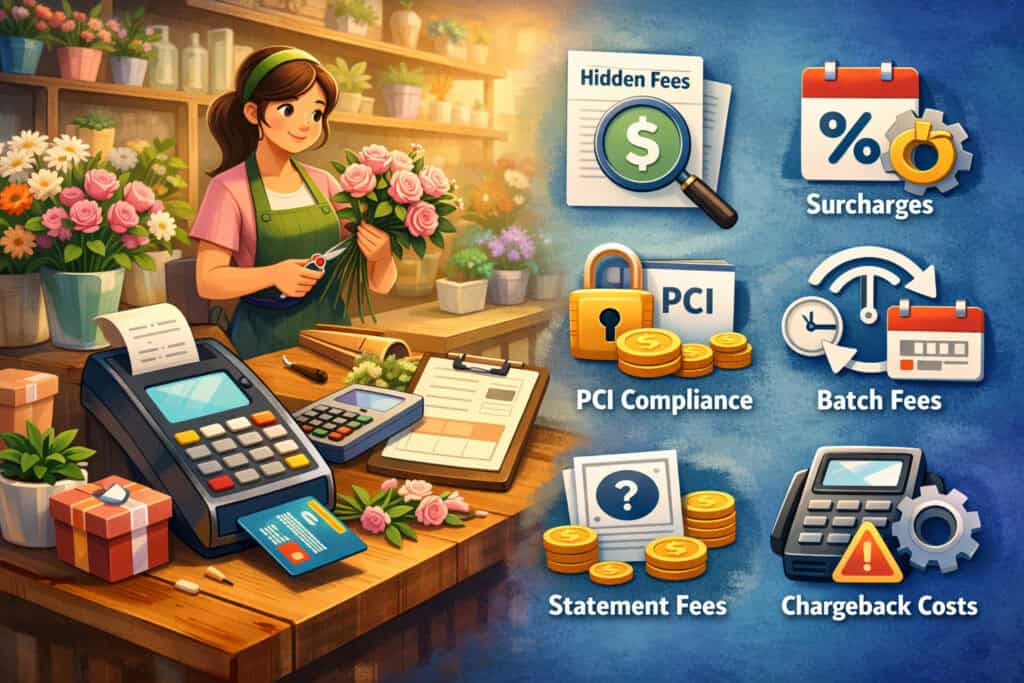
When florists talk about hidden credit card processing fees for florists, they are usually talking about charges that show up after onboarding and were not meaningfully explained upfront.
These fees can be recurring, one-time, or triggered by specific events. Some are standard in the industry. Some are inflated. Some are avoidable. The key is knowing which is which.
One of the most common charges is the monthly statement fee. It may sound minor, but it is often unnecessary in modern processing, especially if statements are digital. Then there are PCI compliance fees, which may be charged monthly or annually.
Security matters, but some providers use PCI language to justify inflated or duplicate charges. Chargeback fees are another major pain point. Disputes do cost processors time and money, but some merchants are surprised by how high these fees are, or by being charged even when the dispute is resolved in their favor.
Monthly minimums are also common. These require you to generate a certain amount in processing fees each month or make up the difference. That can be especially frustrating for florists during slower seasons.
Payment gateway fees may apply if you process online or use virtual terminals. Batch fees can appear every time you settle out of your terminal. Annual fees, account maintenance fees, and customer service fees may also be tucked into the agreement.
Then there are equipment-related costs. A terminal purchase may be fine. An expensive, non-cancelable equipment lease often is not. Many shop owners discover too late that they are paying several times the true value of the equipment over the life of the lease.
Finally, pricing markups themselves can be hidden. A processor may quote one rate but move some transactions into expensive non-qualified rates or use tiered pricing in a way that increases your actual cost far beyond what you expected.
Recurring fees that quietly drain florist profit margins
Recurring fees are dangerous because they become background noise. They show up month after month, often in small amounts, and many business owners stop noticing them.
But for a flower shop with tight margins and variable sales, these fixed charges can put pressure on profitability, especially during slower weeks and off-peak months.
Common recurring charges include monthly statement fees, monthly minimums, PCI compliance fees, gateway fees, and general account maintenance fees.
Some processors also charge separate fees for reporting portals, customer support, or online access tools that should arguably be included. None of these may feel devastating on their own. Together, they can materially raise your total cost of acceptance.
For florists, recurring fees are especially frustrating because they do not always scale with sales. If you have a slow month after a major holiday or a lull between event seasons, your recurring charges remain.
That means your effective processing rate can look much worse during low-volume periods, even if your quoted transaction rate appears reasonable. The solution is to calculate total monthly cost, not just transaction percentage.
If one provider offers a slightly higher per-transaction rate but no monthly junk fees, it may actually be cheaper than a processor advertising a lower swipe rate with a long list of recurring add-ons. Many owners focus too much on the headline rate and not enough on the full monthly picture.
Event-based and surprise fees that show up when something goes wrong
Some of the most painful merchant account fees do not appear every month. They show up when there is a problem, a change, or an unusual transaction. That is exactly why they feel like surprises. Since they are not part of your regular routine, you may not think to ask about them before signing.
Chargeback fees are a major example. In a flower shop, disputes may happen over delivery timing, product expectations, event cancellations, duplicate charges, or customer confusion around pre-orders and deposits.
Even if you have proof of service, the processor may still charge a fee just because the dispute was filed. Those fees can be significant, especially if you get several during a busy season.
Cancellation fees and early termination fees are another issue. Some processors lock merchants into multi-year contracts with heavy penalties for leaving early. Others auto-renew unless you cancel during a narrow window.
Florists who switch POS systems, change providers, or close a seasonal location can get caught by these terms at the worst time.
Batch fees, retrieval request fees, address verification fees, and annual compliance fees can also appear unexpectedly. None of these are necessarily fake, but they should be disclosed clearly from the beginning. If they are not, they become hidden costs in every practical sense.
Pro Tip: Ask every processor for a complete list of “all possible fees, including fees triggered by disputes, cancellation, low volume, annual renewals, compliance, batching, and online orders.” Get the answer in writing.
Understanding Interchange Fees, Processor Markups, and Why Statements Look So Confusing
One reason payment statements feel so hard to understand is that your total cost is usually made up of at least two layers. First are interchange fees, which are base costs tied to the card networks and issuing banks.
Second are processor markups, which are what your payment company adds on top. If you do not understand the difference, it becomes difficult to tell whether your pricing is fair.
Interchange fees are not usually the hidden part. They are built into the payment ecosystem and vary depending on factors such as card type, transaction method, and business category. A rewards card may cost more than a basic debit card.
A card-present transaction may cost less than a keyed-in one. Online and manually entered payments often carry higher costs because they present more risk.
The real opportunity for hidden pricing often sits in the processor markup. That is where providers may add basis points, per-transaction charges, monthly fees, gateway fees, and other service costs.
If a statement does not clearly separate interchange from markup, it becomes harder to see what the processor is truly charging you.
This matters for florists because your transaction mix may shift constantly. One week may be full of card-present bouquet sales. Another may include phone orders for funerals, online anniversary purchases, and wedding deposits.
Without transparent reporting, your processor can blame rising costs on interchange when the bigger issue may be its own pricing structure.
Statements are also confusing because providers use inconsistent labels. The same type of cost may appear under different names from one company to another.
Some statements bury fees in summary sections instead of attaching them to transaction categories. Others group large numbers together in ways that hide where the markup really comes from.
How interchange and markup work together in real life
Think of interchange as the wholesale cost and the processor markup as the retail add-on. You are rarely able to eliminate interchange, but you can absolutely compare and negotiate the markup layer. That is where transparent merchant services separate themselves from processors that rely on confusion.
For example, when a customer taps their card in your flower shop, the payment may carry one underlying interchange cost. When another customer calls in a delivery order and you manually key the card, the interchange may be higher.
Your processor then adds its own markup to both. If the markup is reasonable and clearly disclosed, you can plan around it. If the markup is vague or inflated, your costs become unpredictable.
This is why interchange-plus pricing is often viewed as more transparent. It separates the base cost from the processor’s fee. You can see that some transactions cost more because of the card type or entry method, while also seeing exactly what the processor is making.
That does not automatically make interchange-plus the cheapest choice for every florist, but it usually makes it easier to understand.
When owners do not see this breakdown, they often misdiagnose the problem. They assume rising fees are just “what card processing costs now,” when in reality the markup may have changed, or certain transaction types may be getting downgraded into more expensive categories.
Why merchant statements feel designed to discourage review
A lot of flower shop owners are capable of understanding their statement once it is explained well. The issue is not intelligence. The issue is that many statements are cluttered, inconsistent, and full of abbreviations that do not help the merchant understand actual costs. Some processors benefit when merchants feel too overwhelmed to question anything.
You may see sections for discount fees, transaction fees, network access fees, authorization fees, PCI programs, batch charges, retrieval fees, and various “service” or “maintenance” items.
Some fees appear as percentages, others as flat amounts. Some are monthly. Some are daily. Some are only triggered under certain conditions. It is easy to scan the first page, see your total deposits, and move on.
For flower shops, the confusion grows when multiple systems are involved. Your POS system fees may be billed separately from your merchant account fees. Your website platform may have its own payment charges.
Your payment gateway fees may sit on another invoice entirely. Unless you gather all of those costs in one place, you may underestimate the true cost of credit card processing for flower shops.
The most useful habit is to stop relying on the processor’s categories alone. Rebuild the picture yourself. Separate fixed monthly costs, per-transaction costs, card-present costs, keyed-in costs, online costs, and one-off penalties. That simple exercise often reveals hidden markups faster than any sales conversation ever will.
Comparing Flat-Rate, Interchange-Plus, and Tiered Pricing Without the Confusion
Pricing models are one of the biggest reasons flower shop owners struggle to compare processors. Two providers can advertise very different structures while both claiming to save you money.
To avoid hidden credit card fees at your flower shop, you need to understand how the main pricing models work and where the surprises tend to happen.
Flat-rate pricing is the easiest to understand. You pay a set percentage and fixed transaction fee for certain transaction types. Many owners like it because it is predictable and simple. For smaller shops or newer florists, that simplicity can be valuable.
The downside is that flat-rate pricing is not always the cheapest, especially if you have a healthy amount of lower-cost debit transactions or high card-present volume.
Interchange-plus pricing breaks out the underlying interchange fees and adds a clearly stated markup. It is often favored by businesses that want more transparency and are willing to review statements more closely.
This model can work well for established florists that process enough volume to benefit from lower markups, but it requires a provider that actually gives clean reporting.
Tiered pricing is where many hidden fee issues appear. Transactions are grouped into buckets such as qualified, mid-qualified, and non-qualified.
The problem is that the rules behind those categories can be hard to understand and easy for the processor to control. A low advertised qualified rate may sound good, but many of your real-world transactions may land in more expensive categories.
For flower shops with mixed payment methods, tiered pricing can get expensive fast. Phone orders, online orders, rewards cards, or manually keyed transactions may not qualify for the best rate. That can leave you paying much more than expected, especially during busy delivery or event periods.
When flat-rate pricing makes sense for a florist
Flat-rate pricing often appeals to flower shop owners because it is clean and fast to understand. You do not need to decode interchange tables or track a separate markup. If most of your sales are relatively straightforward and you value simplicity over squeezing out every possible basis point, flat-rate pricing can be a practical option.
This model can work especially well for newer shops, low-to-moderate processing volume, or owners who want easy budgeting.
If your business relies on a simple countertop setup and a modest online store, a straightforward flat rate may reduce administrative headaches. Some bundled systems also make it easier to connect your POS, inventory, and payments under one roof.
The risk is that simplicity can hide the total cost. A flat rate that feels convenient may be quietly expensive if your transaction mix would otherwise qualify for lower interchange in a more transparent model. If your shop runs many card-present transactions or large-ticket event orders, the difference can add up.
Flat-rate pricing is not bad by default. It becomes a problem when it is sold as universally cheap. For florists, the real question is whether the convenience is worth the extra cost and whether the provider also piles on monthly statement fees, gateway fees, or other charges that erase the simplicity benefit.
Why tiered pricing deserves extra caution from flower shops
Tiered pricing is often where hidden pricing markups become hardest to detect. A processor may advertise a very attractive qualified rate, but that rate applies only to a narrow set of transactions.
Once real-world payments start flowing, many sales may be downgraded into mid-qualified or non-qualified rates, which can be significantly more expensive.
For florists, this is a major concern because your business naturally includes transaction types that tend to trigger downgrades. Keyed-in transactions from phone orders, online flower shop payments, delivery order payments, and premium rewards cards can all end up outside the lowest-cost tier.
Wedding flower payments and custom event deposits may also involve payment patterns that do not fit the processor’s ideal definition of “qualified.”
The result is a pricing model that looks affordable in a pitch but performs poorly in practice. It also makes statements harder to audit because you are not seeing a clean pass-through of interchange and markup. Instead, you are seeing broad categories that may hide how and why your costs increased.
If a processor wants to put your flower shop on tiered pricing, ask them for historical examples showing what percentage of a florist’s transactions typically fall into each tier. If they cannot answer clearly, that is a warning sign.
Pro Tip: If a rate sounds unusually low, ask what percentage of your transactions are realistically expected to qualify for it. A low rate means little if most of your sales never receive it.
How Different Payment Methods Change Your Costs
Not all card payments cost the same. This is one of the most important concepts for florists to understand, because your shop may accept payments in several ways throughout the week. The method used to take payment affects risk, and risk affects pricing.
Card-present transactions are usually the most cost-effective. When a customer inserts, taps, or swipes in person, the transaction is generally considered more secure than a manually entered one.
For a flower shop, these are your everyday walk-in sales at the counter. If your business leans heavily on in-store purchases, you may have more room to negotiate favorable pricing.
Keyed-in transactions tend to cost more. These happen when a card number is manually entered, often for phone orders, special requests, or delivery order payments.
Since the card is not physically present, the chance of fraud or disputes is higher. Florists often process a meaningful share of orders this way, especially during busy holidays, which means those higher costs can add up quickly.
Online flower shop payments are another category. These can include payment gateway fees, fraud tools, tokenization charges, and card-not-present rates.
They are essential for modern commerce, but they need careful review. Some processors are transparent about these costs. Others spread them across multiple invoices or labels, making the total look smaller than it is.
Event and wedding flower payments may come through invoices, payment links, or manually entered deposits. Delivery drivers may collect payments remotely. Each setup can affect cost and dispute exposure. The more payment channels you operate, the more important it is to understand channel-specific pricing.
In-store, phone, and remote payments do not carry the same risk
It is easy to assume a sale is a sale. But to a processor, the way the sale is captured matters a lot. A customer tapping their card at your register is not viewed the same way as someone giving a card number over the phone for a same-day delivery.
That is why your florist credit card processing fees may vary more than expected from one transaction type to another.
In-store card-present payments are usually preferred because the card’s chip or contactless data provides stronger verification. These transactions are often the most cost-efficient for florists.
That makes it worth ensuring your hardware and POS system support modern card acceptance and that staff are trained to avoid unnecessary manual key entry.
Phone orders are common in flower shops, especially for sympathy arrangements, last-minute gifts, and customers who prefer calling. But keyed-in transactions come with higher cost and more dispute risk.
If you rely heavily on them, even a seemingly small markup difference can materially increase monthly processing expense.
Remote payments for deliveries or special events can raise similar issues. If your team enters cards manually away from the counter or uses less secure methods, costs and chargeback risk may rise.
That does not mean you should stop offering convenience. It means your processor should help you manage it clearly and fairly.
Online orders and wedding deposits need tighter controls
Online flower shop payments and wedding flower payments are often profitable sales channels, but they also require more discipline around payment handling.
These transactions can involve larger ticket amounts, future delivery dates, custom design expectations, and more customer communication. All of those factors affect both fees and disputes.
For online orders, check whether your e-commerce platform charges separately from your processor. Some owners pay platform transaction fees, gateway fees, and processor fees without realizing they are stacking costs.
Also review whether fraud tools are included or billed separately. A good fraud tool may be worth the cost, but only if you know you are paying for it.
Wedding deposits and event payments need clear invoicing, cancellation terms, and service descriptions. Larger custom orders are more likely to attract scrutiny if something changes.
If the payment is taken far in advance or in multiple installments, make sure your documentation is strong. Good records help reduce chargeback exposure and make higher-risk transactions easier to defend.
For florists, the cheapest transaction is not always the best one. The goal is to create a payment process that supports sales, protects the customer experience, and keeps costs visible and manageable.
How to Review Your Merchant Statement and Spot Red Flags Fast
A merchant statement should help you understand your costs. Too often, it does the opposite. That is why learning to review it properly is one of the most effective ways to avoid hidden credit card fees at your flower shop. You do not need to master every payment term. You just need a repeatable way to identify what matters.
Start by separating total fees into categories. Look for transaction-based fees, recurring monthly fees, annual or compliance fees, and one-off penalty fees. Then calculate your effective rate by dividing total processing cost by total card sales. This tells you what you are really paying overall, not just what you were quoted.
Next, compare the statement to your agreement. Are you being charged fees you do not remember approving? Did a promotional rate disappear? Has a monthly fee increased?
Are there line items for services you are not using, such as gateway tools tied to an old website, extra reporting modules, or duplicate PCI programs? These are common places where hidden charges live.
You should also review transaction categories. If you are on tiered pricing, how many transactions landed in non-qualified rates? If you are on interchange-plus, can you clearly see the markup? If the statement makes this impossible to determine, that is a red flag in itself.
For florists, review statements during both slow and busy periods. Seasonal sales can change your cost mix, and some fees only become obvious when volume spikes. If you only review one average month, you may miss the most expensive patterns.
The fastest way to audit a statement without getting overwhelmed
The biggest mistake merchants make is trying to understand everything at once. A better approach is to work through your statement in a simple order.
First, confirm total card sales. Second, confirm total fees. Third, calculate effective rate. Fourth, identify every recurring fee. Fifth, look for unusual one-time charges or categories you do not recognize.
This process immediately turns a confusing document into a manageable checklist. If your effective rate is much higher than the rate you thought you signed up for, you know there is a gap worth investigating.
If recurring fees look inflated, you can challenge them or compare providers. If one-time fees appear during specific months, you can trace what triggered them.
For flower shops, it is helpful to annotate the statement with business context. Was it a heavy delivery month? Did you run more online orders? Did you process large wedding deposits? Matching statement patterns to real business activity helps you see whether costs make sense or whether the processor is using complexity to hide markups.
One overlooked tactic is comparing statements from the same season year over year. If your sales mix is similar but fees increased noticeably, it may point to creeping charges or pricing changes that were not properly disclosed.
Red flags that usually signal overpriced or misleading processing
Some statement problems are more serious than others. A few are strong indicators that your processor relationship needs closer review. One is a large gap between the quoted rate and your actual effective rate without a clear explanation. Another is frequent use of vague labels such as service fees, maintenance fees, or program fees with no detail attached.
Excessive non-qualified charges are another major warning sign, especially for florists under tiered pricing. If a large share of your transactions land in expensive buckets, your advertised rate may be little more than a teaser. Duplicate-looking charges, especially around PCI compliance or online tools, should also be investigated immediately.
Watch for annual fees that appear with little notice, equipment charges that continue after you thought the device was paid off, and gateway fees tied to systems you no longer use. Auto-renewed contracts and early termination clauses can also reveal themselves in statements or notices that merchants ignore until it is too late.
If a processor cannot explain your statement in a clear and consistent way, that alone is a concern. A trustworthy provider should be able to walk a florist through major fees, transaction categories, and markup logic without turning the conversation into a maze.
How to Choose Transparent Credit Card Processing for Flower Shops
Choosing transparent credit card processing for flower shops is not about finding the lowest advertised rate. It is about finding a provider whose pricing structure, contract terms, support, and reporting actually fit the way a florist operates.
A cheap-looking offer with unclear fees can cost far more than a slightly higher rate that is honest and well-structured.
Start by asking for full pricing disclosure in writing. That includes transaction fees, monthly fees, annual fees, gateway fees, chargeback fees, batch fees, PCI fees, equipment costs, and cancellation terms.
Ask whether rates vary by card type, payment method, or sales channel. Ask how online, keyed-in, and card-present transactions are billed. Ask whether there are monthly minimums or non-qualified rates.
Then look at contract terms. Transparent merchant services should not rely on long, restrictive agreements to keep your business. Review early termination fees, auto-renewal language, notice requirements, and any equipment lease commitments. A fair processor should be able to win your business on value, not penalties.
Support also matters. Flower shops often need help during busy seasons, website issues, or urgent disputes. If customer service is hard to reach or outsourced in a way that creates delays, that can cost you more than a small pricing difference ever would. Good support is part of the value of your processor relationship.
Finally, consider fit. A florist with a heavy mix of online and delivery orders needs different tools than a mostly walk-in retail shop. Choose a provider that understands your transaction mix and can explain how their model works for seasonal sales, event deposits, and multiple payment channels.
Questions every florist should ask before signing
A strong sales conversation should leave you with fewer questions, not more. Before committing to a processor, ask direct, specific questions that force clear answers. Ask for the full fee schedule. Ask for a sample statement. Ask how your costs would differ for in-store sales, keyed-in phone orders, and online flower shop payments.
You should also ask whether pricing is flat-rate, interchange-plus, or tiered. If it is tiered, request written definitions of what qualifies for each bucket. If it is interchange-plus, ask exactly what the markup is and whether any additional fees apply on top. If it is flat-rate, confirm whether separate monthly or gateway fees still exist.
Do not overlook equipment questions. Ask whether the terminal is purchased or leased, what happens if you cancel service, and whether the device is locked to the processor. If your shop already has a POS system, ask whether it integrates cleanly or requires extra gateway services that carry added fees.
For florists, support and chargeback handling are also critical. Ask how disputes are managed, what the chargeback fee is, and what kind of evidence the processor helps you submit. The better these answers are upfront, the lower the chance of ugly surprises later.
Sales tactics and contract tricks to watch out for
Some processing sales tactics sound helpful but are designed to move the conversation away from total cost. One common tactic is rate anchoring.
The rep keeps repeating one low rate without discussing the fees, transaction types, or pricing tiers that determine what you will actually pay. Another is rushing the decision by implying that the offer expires soon or that setup must happen immediately.
Watch out for verbal promises that are not reflected in the agreement. If a rep says there is no cancellation fee, no annual fee, or no monthly minimum, that language should appear in writing.
Flower shop owners are often targeted with convenience-driven pitches because processors know you are busy and focused on customers, not contracts.
Auto-renewal terms deserve careful review. So do non-cancelable equipment leases. A processor may present a terminal bundle as affordable while locking you into years of payments on hardware worth a fraction of the total lease cost. Another common issue is “free” equipment that is only free if you keep service for a certain term or volume level.
Bad contracts usually depend on complexity, urgency, or misplaced trust. Slow the conversation down, ask for documents before signing, and compare total cost, not just marketing claims.
Practical Ways to Reduce Credit Card Processing Costs Without Hurting Customer Experience
The goal is not to eliminate card acceptance costs entirely. Customers expect payment convenience, and that convenience supports sales. The smarter goal is to reduce florist payment processing costs in ways that protect margin without making checkout harder or creating friction.
One of the simplest ways to reduce cost is to encourage more secure, lower-risk payment methods. In-store tap or chip transactions usually cost less than keyed-in orders. If staff are manually entering cards out of habit, fix the workflow. Make it easier to use the terminal properly and harder to bypass it.
You should also review your online and remote payment setup. If your website, gateway, and processor are all charging fees separately, there may be a better-integrated solution. If you take many delivery and phone orders, consider whether secure payment links or hosted invoices could reduce keyed-in volume and improve documentation.
Another important strategy is pricing review. Not all merchants should use cash discounting or surcharging, and surcharge rules can be complex depending on card brand requirements and local rules. But understanding these tools matters.
In some cases, a compliant cash discount program may help offset costs without damaging customer goodwill. In other cases, it may be better to keep pricing simple and focus on lowering processor markup instead.
Finally, strong internal processes reduce costs indirectly. Clear receipts, delivery confirmations, refund policies, and order records can cut chargebacks. Better payment data and regular statement review can help you catch fee creep early.
Simple operational changes that lower fees over time
Not every cost-saving move requires changing processors. Many florists can reduce fees just by improving how payments are handled day to day. Start with your team. Train staff to avoid unnecessary keyed-in transactions and to settle batches consistently. Small process errors repeated many times can create avoidable costs.
Review your checkout tools. If your terminal is outdated or your POS system makes card-present transactions harder than they should be, that is an operational issue with financial consequences. A modern system that supports chip, tap, and integrated reporting may lower cost enough to justify the upgrade.
For phone and delivery orders, use tools that improve verification and recordkeeping. Secure payment links, invoice-based collection, and digital receipts can help reduce disputes compared with casual manual entry. Better delivery confirmation, itemized order details, and customer communication also reduce post-sale conflict.
Flower shops should also time statement reviews strategically. Look at fees right after major seasonal periods, because that is when the cost impact of weak systems becomes easiest to see. If a holiday rush always brings a higher effective rate, there is probably a workflow or pricing issue worth fixing before the next season arrives.
Cash discounting, surcharges, and customer-friendly cost control
Cash discounting and surcharging are often discussed as ways to reduce small business payment processing costs, but they need careful handling.
A surcharge adds a fee to certain card transactions, while a cash discount offers a lower price to customers paying by cash. The difference matters legally, operationally, and from a customer experience standpoint.
For florists, these approaches can be tricky because many purchases are emotional, urgent, or convenience-driven. Someone buying sympathy flowers or a last-minute arrangement may react poorly to unexpected checkout fees.
Wedding clients and event customers may be more understanding if pricing is communicated clearly in advance, but even there, trust matters.
If you consider these strategies, make sure the program is compliant, clearly disclosed, and aligned with card brand rules and applicable regulations. More importantly, evaluate how it fits your brand.
A boutique florist built on service and presentation may decide the customer experience tradeoff is not worth it. Another shop with steady local traffic may find a well-designed cash discount program workable.
In many cases, the best path is still reducing hidden markups, improving transaction methods, and tightening operations rather than passing costs directly to customers. Customer-friendly cost control usually starts behind the scenes.
A Step-by-Step Checklist to Avoid Hidden Charges at Your Flower Shop
If all of this feels like a lot, focus on one thing: you do not need to fix everything at once. The best way to avoid hidden credit card fees at your flower shop is to follow a repeatable checklist whenever you review your current setup or shop for a new processor.
Start with your current costs. Gather three recent processing statements, your merchant agreement, your POS billing, and any invoices for gateway or online payment tools. Calculate your total monthly card costs and effective rate. Separate card-present, keyed-in, and online costs if possible. This gives you a clean baseline.
Next, identify every fee. Highlight monthly statement fees, PCI compliance fees, chargeback fees, payment gateway fees, batch fees, annual fees, equipment charges, and monthly minimums. Make sure you know which are recurring and which are event-based. If you cannot explain a fee, flag it for review.
Then evaluate your pricing model. Are you on flat-rate pricing, interchange-plus, or tiered pricing? If tiered, how many transactions are being pushed into non-qualified rates? If interchange-plus, is the markup clear? If flat-rate, are extra fixed charges making the overall deal less attractive than it appears?
After that, review contract terms. Check for early termination fees, auto-renewal dates, equipment lease obligations, and notice requirements. Many hidden costs only become visible when a florist tries to switch providers or cancel service.
Finally, compare alternatives carefully. Do not compare only by advertised rate. Compare by total cost, fee transparency, contract flexibility, support quality, and fit for your sales channels.
The flower shop owner’s fee-avoidance checklist
Use this checklist whenever you review or replace a processor:
- Gather at least three months of merchant statements
- Calculate your true effective rate
- List every recurring fee and one-time fee
- Identify your pricing model and how it works
- Separate in-store, phone, delivery, and online payment costs
- Review your gateway, POS, and merchant account bills together
- Check for PCI fees, monthly minimums, batch fees, and annual fees
- Review chargeback fees and dispute support
- Confirm whether equipment is owned, financed, or leased
- Read contract terms for auto-renewal and early termination fees
- Ask for full written pricing from any new provider
- Compare total monthly cost, not just headline rates
This checklist matters because hidden fees are usually not hidden in only one place. They are scattered across statements, contracts, software invoices, and hardware agreements. Bringing them together is how you see the full picture.
For florists, this process is especially valuable before busy seasons, new website launches, POS upgrades, and event-heavy periods. Those are the moments when bad pricing gets most expensive.
What new and established florists should focus on first
New flower shop owners often need simplicity. If you are just getting started, focus first on avoiding bad contracts and unnecessary recurring fees.
You want a processor that makes pricing easy to understand, integrates with your basic tools, and does not trap you in an expensive long-term agreement. Predictability matters when cash flow is still stabilizing.
Established florists often have a different challenge. You may already have multiple systems, legacy pricing, a website platform, a delivery workflow, and long-standing merchant service habits that nobody has reviewed in years.
In that case, your biggest opportunity may be auditing what you already use. Many mature shops can lower costs significantly without changing their customer-facing experience at all.
Event-focused florists should pay close attention to deposits, invoices, and chargeback controls. Retail-focused florists should emphasize card-present efficiency and equipment clarity. Shops with strong online and delivery volume should review gateway fees, remote payment methods, and fraud tools.
No matter your stage, the first step is the same: stop assuming your current setup is fine just because payments are processed successfully. Smooth transactions do not always mean fair pricing.
FAQ
Q.1: What are the most common hidden credit card processing fees for florists?
Answer: The most common hidden credit card processing fees for florists include monthly statement fees, PCI compliance fees, chargeback fees, batch fees, gateway fees, monthly minimums, annual fees, and equipment lease charges.
Some florists also run into pricing markups hidden inside tiered pricing, especially when transactions are downgraded into non-qualified rates without a clear explanation.
What makes these fees feel hidden is not always that they are completely undisclosed. Often, they are buried in contracts, presented vaguely during the sales process, or described in a way that does not show how often they will actually apply.
For a flower shop, these costs can build quickly because your business may accept payments in-store, by phone, online, and for delivery.
The best protection is asking for a complete written fee schedule, reviewing statements monthly, and calculating your true effective rate rather than relying on the advertised swipe rate alone.
Q.2: Is flat-rate pricing better than interchange-plus for a flower shop?
Answer: Neither model is automatically better for every flower shop. Flat-rate pricing is easier to understand and can work well for smaller shops, lower volume businesses, or owners who value simple budgeting. It is often appealing for straightforward retail environments where convenience matters more than detailed fee analysis.
Interchange-plus pricing is usually more transparent because it separates interchange fees from the processor’s markup. This can be a strong fit for established florists or shops with enough card volume to benefit from lower markups and clearer reporting. The tradeoff is that statements may require more review.
The right choice depends on your sales mix. If your flower shop handles a lot of card-present transactions, wedding deposits, delivery orders, and online payments, the pricing model should be evaluated against those real conditions.
The important thing is not choosing the trendiest model. It is choosing the one that gives you clear visibility into your florist payment processing costs.
Q.3: Why do phone orders and delivery payments often cost more to process?
Answer: Phone orders and many delivery order payments are usually processed as keyed-in transactions, which are considered riskier than card-present payments. Since the card is not physically inserted or tapped, processors and card networks often apply higher costs to reflect the increased chance of fraud or disputes.
This matters a lot for florists because phone orders are common in the business. Customers often call for sympathy arrangements, same-day gifts, wedding deposits, and special delivery requests.
Those transactions may be essential to revenue, but they can carry higher florist credit card processing fees than an in-store sale at the counter.
That does not mean you should avoid those sales. It means you should handle them thoughtfully. Secure payment links, digital invoices, better verification methods, and strong order documentation can reduce risk and sometimes improve your overall cost picture.
If a large portion of your shop’s revenue comes from phone and delivery orders, your processor should be able to explain clearly how those transactions are priced.
Q.4: How can I tell if my processor is overcharging my flower shop?
Answer: The clearest way to tell is to calculate your effective rate. Divide your total processing costs by your total card sales for the month. Then compare that number with what you believed your pricing was supposed to be. If the gap is large and the processor cannot explain it clearly, you may be overpaying.
You should also look for specific warning signs. These include vague fees, a high number of non-qualified transactions under tiered pricing, recurring charges you do not remember agreeing to, duplicate-looking PCI or gateway fees, and expensive equipment lease payments.
If your statement is so confusing that nobody can explain it in straightforward terms, that alone is a problem.
For flower shops, it is also smart to compare busy-season statements with slower months. If your effective rate climbs sharply during holidays, wedding season, or periods of heavy delivery volume, you may be seeing hidden pricing behavior tied to transaction type or volume. Overcharging is often easiest to spot when your business is busiest.
Q.5: Are cash discounting or surcharges a good way to cut processing costs for florists?
Answer: They can help in some situations, but they are not automatically the best answer for every flower shop. Cash discounting lowers the posted price for customers who pay with cash, while surcharging adds a fee to certain card transactions. Both can offset processing costs, but both also require careful handling.
For florists, customer experience matters a lot. Many purchases are emotional, urgent, or tied to special occasions. A surprise checkout fee can create friction at the wrong moment. That does not mean these programs never work.
Some shops implement them successfully with clear signage, compliant setup, and a customer base that accepts the model.
Still, many florists will get better long-term results by lowering processor markups, improving transaction handling, reducing keyed-in payments where possible, and tightening statement review.
Before introducing any pricing adjustment program, measure how much you could save by fixing your existing setup. In many cases, hidden fees and weak pricing structure are the bigger problem than the base cost of card acceptance itself.
Q.6: What should I do first if I want to avoid hidden credit card fees at my flower shop?
Answer: Start by gathering your last three months of processing statements, your merchant agreement, and any separate bills for your POS system, payment gateway, or online checkout tools.
Then calculate your total monthly processing cost and effective rate. This creates a real baseline for your shop instead of relying on memory or sales promises.
Next, make a simple list of every fee you can find. Include recurring charges like statement fees, PCI compliance fees, monthly minimums, and gateway fees, along with event-based charges such as chargeback fees or batch fees.
Once you see them all in one place, it becomes much easier to tell what is normal, what is unnecessary, and what needs to be questioned.
After that, review your pricing model and contract terms. Find out whether you are on flat-rate, interchange-plus, or tiered pricing, and check for early termination fees or equipment lease obligations.
That first review will usually tell you whether your current setup is worth keeping or whether it is time to compare more transparent credit card processing for flower shops.
Conclusion
Credit card acceptance is part of modern flower retail, but confusion should not be part of the deal. If you want to avoid hidden credit card fees at your flower shop, the most important shift is moving from passive acceptance to active review.
Hidden charges thrive when owners are busy, statements are complicated, and pricing is presented in pieces instead of as a full picture.
Flower shops are especially exposed because of mixed payment channels, seasonal sales, delivery orders, online checkout, and event deposits. That does not mean high costs are unavoidable.
It means your business needs a processor that is transparent about merchant account fees, payment gateway fees, PCI compliance fees, chargeback fees, pricing markups, and contract terms from the start.
The good news is that you do not need to memorize every technical detail to protect your margin. You just need to know what fees exist, how pricing models work, how payment methods affect costs, and how to review your statements with purpose.
Once you do, hidden credit card processing fees for florists become much easier to spot and much harder for a provider to sneak through.
A good payment setup should support your shop’s growth, not quietly drain it. When your pricing is clear, your systems are aligned, and your statements are understandable, you can spend less time second-guessing processing costs and more time focusing on the work that actually grows your business.