Running a flower shop is not like running a generic retail store. You’re selling perishable products with fast-moving designs, seasonal spikes, timed deliveries, add-ons (vases, cards, chocolates), and orders that often start in one channel (phone or social) and finish in another (in-store pickup or delivery).
That’s why choosing the best POS systems for flower shops matters: the right point of sale is less about “ringing up a sale” and more about controlling inventory, organizing custom orders, managing delivery workflows, and keeping customer service consistent during rush periods.
A modern POS system for florists should help you build bouquets quickly, handle substitutions, track stems and supplies, store customer preferences, and sync online orders with in-store operations.
It should also support clear reporting so you know what actually drives profit (arrangement types, add-ons, delivery fees, peak days) instead of guessing.
In this guide, you’ll find the best POS systems for flower shops based on real-world florist needs—plus what to look for, how to compare options, common mistakes, and where POS technology is heading next (including automation and AI-driven retail trends).
What makes a flower shop POS different from a regular retail POS?
A standard retail POS is built for items that don’t expire, have stable SKUs, and are easy to count. A flower shop is the opposite. You have perishables, shrink, substitutions, and custom work. The best POS systems for flower shops support day-to-day florist workflows such as:
- Custom order building: arrangements aren’t one fixed SKU; they’re designs with sizes, style notes, and substitutions.
- Timed fulfillment: delivery windows, pickup times, and “must-go-out” routing.
- Seasonality and spikes: Valentine’s Day, Mother’s Day, prom, weddings, funerals—your POS must stay fast under heavy volume.
- Complex inventory reality: you might track “rose stems” and “greenery bundles,” not just “Product A / Product B.”
A florist-ready POS either includes florist-specific features (orders + delivery + events) or it integrates cleanly with florist software.
Many flower shops also need a POS that works smoothly with barcode scanning, purchase orders, and quick stock adjustments—capabilities that retail-focused platforms like Square and Lightspeed emphasize in their inventory toolsets.
How to choose the best POS system for a flower shop
When shopping for the best POS systems for flower shops, start by mapping your actual order flow. Don’t buy based on brand recognition alone—buy based on whether the POS matches how your shop works.
Step 1: Identify your primary sales mix
If most orders are walk-in, you’ll prioritize speed at checkout, inventory counts, and add-ons. If you do lots of phone orders and delivery, you’ll prioritize customer profiles, delivery scheduling, and order notes. If you sell online heavily, omnichannel sync becomes critical.
Step 2: Define what “inventory” means in your shop
Some shops track inventory at the finished-product level (arrangement SKUs). Others track at the ingredient level (stems, ribbons, vases). Many do a hybrid: basic stem counts + finished SKU library for popular designs. Retail POS platforms often shine for structured inventory tools like item creation, barcode scanning, stock adjustments, and purchase orders.
Step 3: Decide if you need florist-specific workflows
Florist-focused systems (like Floranext or Hana Florist POS) are designed around florist operations—orders, delivery workflows, and florist-centric needs. Floranext positions its product as florist POS plus a florist website and event tools.
Step 4: Pressure-test the POS for peak days
Ask vendors exactly how their checkout screen behaves when you have:
- 50+ open orders
- multiple tenders (split payments)
- delivery fees + tips
- last-minute substitutions and refunds
Peak-day performance is where the “best POS systems for flower shops” prove themselves.
Must-have POS features for flower shops
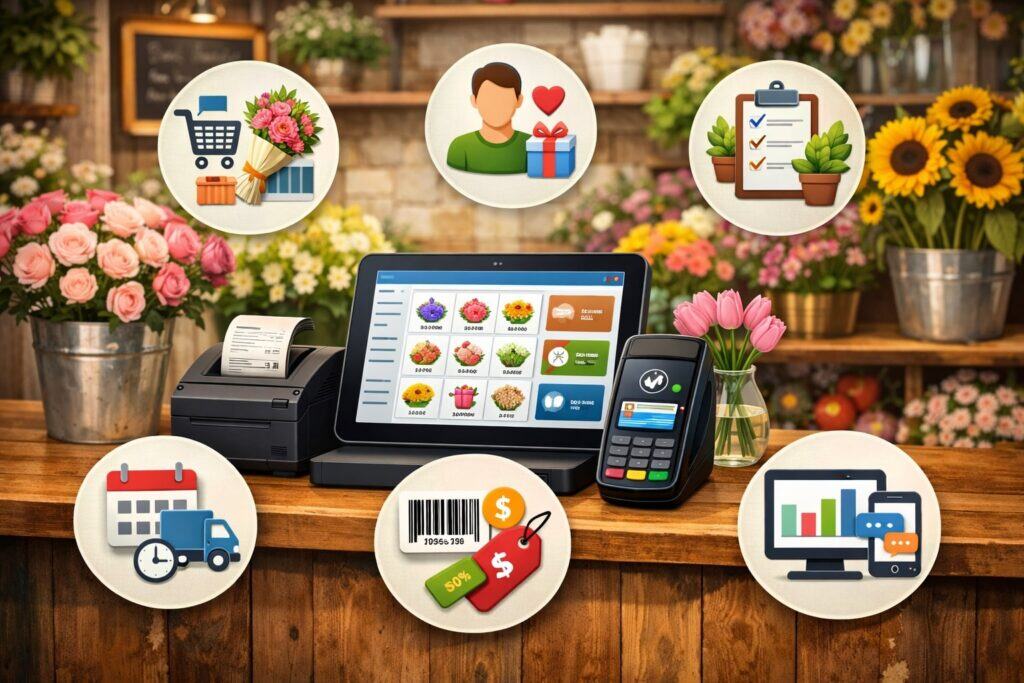
The best POS systems for flower shops are built around five core capabilities—everything else is a bonus.
1) Fast, flexible checkout
You need quick item search, modifiers (like “premium wrap”), tipping (if you accept tips), delivery fee handling, and easy refunds/exchanges.
2) Inventory tools that match your reality
Look for:
- barcode support and item creation options
- stock adjustments and audit trails
- reorder alerts and purchase order workflows
Square, for example, highlights tools like barcode-based item creation, inventory counts, alerts, and purchase orders within its retail capabilities and inventory workflows.
3) Customer profiles + marketing hooks
A flower shop wins on repeat buyers. Your POS should store purchase history, reminders, and customer preferences (favorite flowers, allergy notes, “no lilies,” etc.).
4) Omnichannel consistency
If you sell online and in-store, your POS should keep inventory and customer data aligned. Shopify’s 2025 retail content emphasizes unified commerce and omnichannel strategy as the direction of retail operations.
5) Reporting that answers florist questions
You should easily see:
- top-selling arrangements and add-ons
- delivery revenue vs product revenue
- discounts used and impact on margin
- hourly/day-of-week peaks
Best overall POS system for flower shops: Square for Retail
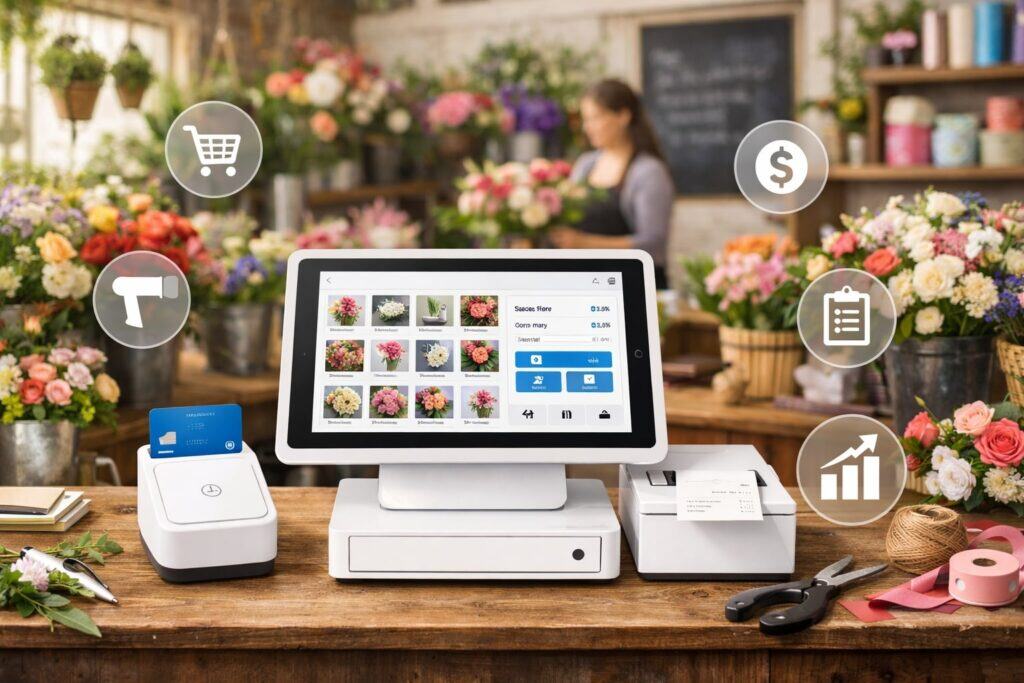
If you want a modern system that’s easy to run, quick to train on, and strong for everyday retail operations, Square for Retail is often a top contender among the best POS systems for flower shops—especially for small and mid-size shops that need speed, reliable hardware options, and strong inventory fundamentals.
Why Square fits flower shops
Square puts a lot of emphasis on practical retail execution: create items, manage variations, scan barcodes, adjust inventory, and set alerts when stock dips. These are the “unsexy” features that keep a florist from running out of vases or selling items you can’t fulfill.
Inventory strengths that matter for florists
A flower shop’s inventory changes constantly. Square supports workflows around viewing, receiving, and adjusting inventory, and it also supports creating items by scanning barcodes—useful for supplies, containers, and add-ons that come with manufacturer barcodes.
Who should choose Square for Retail
Choose Square if you want:
- fast in-store checkout
- straightforward inventory for retail items and supplies
- simple staff permissions and training
- clean reporting without heavy complexity
Square can also be a strong foundation if you use separate florist software for delivery/event workflows and simply need a reliable “money + inventory” core.
Best omnichannel POS system for flower shops: Shopify POS
If your flower shop sells online (or wants to), Shopify POS is a serious option among the best POS systems for flower shops because it’s built to connect in-person selling with online ordering and customer data.
Why omnichannel matters for florists
Florist buyers often browse online, then call to customize, then choose pickup or delivery. That journey breaks easily if your systems are disconnected. Shopify’s retail guidance for 2025 focuses on omnichannel retail and unified commerce—connecting sales channels so the customer experience stays consistent.
Where Shopify POS shines for flower shops
Shopify can be a strong fit when you want:
- one product catalog that serves online and in-store
- local pickup workflows and online-to-store conversion
- customer profiles across channels
- gift products, add-ons, and seasonal collections online
Who should choose Shopify POS
Shopify POS is ideal if:
- you already run (or plan to run) a strong online storefront
- you want to invest in SEO + online ordering as a growth channel
- you want a single system of record for online/in-store transactions
A practical florist strategy is to standardize best-seller arrangements as clean online SKUs while allowing custom orders by phone/in-store for higher-touch customers.
Best advanced inventory POS for flower shops: Lightspeed Retail
If your flower shop has a larger catalog (gift boutique items + plants + supplies), multiple locations, or you want deeper inventory controls, Lightspeed Retail is frequently considered one of the best POS systems for flower shops on the “inventory-heavy retailer” side.
Inventory and purchasing strengths
Lightspeed markets robust retail inventory tools: reorder points, purchasing, supplier management, and multi-location capabilities. For florists with high supply turnover, formal purchase orders and structured receiving can reduce stockouts and last-minute emergency buying.
Lightspeed also highlights inventory forecasting within its analytics ecosystem, which can be helpful for seasonal planning when used carefully (because floral demand can be event-driven, not just trend-driven).
When Lightspeed is worth it
Choose Lightspeed if you need:
- deeper inventory organization and purchasing workflows
- more structured supplier ordering
- multi-location controls
- strong reporting for retail operations
Lightspeed may be “more POS” than a tiny flower shop needs—but for growth-stage florists, it can pay off by professionalizing inventory and purchasing.
Best florist-specific POS system for flower shops: Floranext
If you want florist-first workflows (not generic retail), Floranext is often discussed among the best POS systems for flower shops because it’s positioned specifically for florists and also offers related florist tools like websites and event software.
Why florist-specific software matters
Florists don’t just sell products—they sell outcomes (a birthday surprise, a sympathy arrangement, a wedding look). Florist-focused platforms tend to prioritize:
- order notes and customization
- florist-friendly order entry
- delivery and fulfillment workflows
- wedding/event handling and proposal organization
Floranext explicitly positions its platform around “Florist Website, POS, and Wedding & Event software,” which signals it’s designed to handle how florists actually operate, not just how retailers sell.
Who should choose Floranext
Choose Floranext if:
- your business is primarily floral (not a mixed retail boutique)
- you want a system designed around florist orders and events
- you want a more integrated florist stack (POS + site + event tools)
For flower shops that rely heavily on delivery and wedding/event revenue, florist-native tools can reduce operational friction compared with retrofitting a generic retail POS.
Best delivery-and-operations focused florist POS: Hana Florist POS
Hana Florist POS is another florist-focused contender among the best POS systems for flower shops, particularly if delivery operations, customer communication, and workflow automation are central to your business.
Operational features that appeal to florists
Hana’s own guide frames florist POS selection around florist-specific needs and current trends (2025 and beyond), which reflects a focus on the realities of florist operations rather than generic retail.
Third-party summaries also describe features like automated reminders, live delivery tracking, and a customer portal—capabilities that map directly to a florist’s day-to-day service model.
Who should choose Hana Florist POS
Hana can be a strong fit if your shop:
- does a high volume of delivery orders
- needs delivery visibility and customer updates
- wants more workflow structure for florists and drivers
- values florist-centric support and onboarding
Best budget-friendly approach: a retail POS + florist workflow integrations
Not every flower shop needs an all-in-one florist suite on day one. Many start with a reliable retail POS (for payments, inventory of supplies, and checkout speed) and then layer florist-specific tools for delivery routing, wedding proposals, or specialized order management.
Why this approach works
A retail POS can give you:
- fast checkout
- stable hardware
- clean reporting
- inventory tools for supplies and gift items
Square, for example, emphasizes inventory controls like barcode scanning, purchase orders, and stock alerts—useful for the “retail side” of floral operations.
The trade-off
The downside is you may need integrations (or manual processes) for florist-specific tasks like:
- delivery scheduling
- event proposal workflows
- florist-style order notes and substitutions
This hybrid approach is often best for new shops that need stability now, with a roadmap to add florist-specific layers as volume grows.
Hardware considerations for flower shop POS setups
Hardware is a big part of whether the best POS systems for flower shops feel smooth or stressful. Florists are moving quickly, hands may be wet, and counters are busy with wrapping.
Core hardware most flower shops need
- A main register (tablet or terminal)
- Receipt printer
- Cash drawer (if you take cash)
- Barcode scanner (especially for retail gift items and supplies)
- A secondary mobile device for line-busting or workshop checkout
Square’s ecosystem has been expanding hardware options, including a portable handheld device designed for mobile selling and scanning, which can be useful when staff are away from the main counter.
Practical flower shop setup tips
- Put the main POS where customers naturally stop (don’t force awkward traffic jams).
- Use a scanner for vases/cards/candles—save human attention for floral design, not SKU typing.
- Keep a “rush mode” button layout for peak days: top sellers + add-ons + delivery fee presets.
The best hardware setup is the one that reduces micro-delays. In a flower shop, those delays turn into long lines fast.
Payments, fees, and risk: what flower shops should watch
The best POS systems for flower shops should be transparent about payment processing costs and flexible enough to support how customers prefer to pay (tap, chip, contactless wallets, invoices, and sometimes phone payments).
What to evaluate
- In-person card-present pricing vs keyed-in pricing
- Chargeback support (important for phone orders)
- Refund handling and partial refunds (common with substitutions)
- Tipping controls (if you accept tips)
- Deposit-taking for weddings/events
Why this matters for florists
Florists often take:
- deposits for events
- custom orders with later adjustments
- delivery fees that are not “product revenue”
Your POS reports and receipts should separate these cleanly so accounting and profitability are clear.
Also, if you sell higher-ticket wedding/event work, you’ll want strong documentation: signed estimates, clear invoices, and payment records. This is where florist suites can shine, but retail POS platforms can still work if invoicing and notes are handled well.
Reporting and analytics that actually help flower shops grow
Good reporting is one of the biggest reasons to upgrade to one of the best POS systems for flower shops. The goal is not dashboards—it’s decisions.
Reports that matter most
- Best-selling arrangements by season
- Attachment rate of add-ons (cards, chocolates, balloons, plush)
- Delivery volume by weekday and time window
- Discount usage and margin impact
- Repeat customer rate and average time between purchases
How to use reports operationally
- If vase add-ons attach poorly, train staff to offer them with one specific script.
- If Tuesdays are slow, run a targeted campaign for offices or subscriptions.
- If certain arrangements sell well but have low margin, redesign recipes or adjust pricing.
Retail inventory platforms emphasize data-driven inventory management and reporting as core value—Lightspeed, for example, describes inventory management software that supports real-time tracking, reorder points, and analytics to inform purchasing decisions.
POS integrations flower shops should prioritize
Integrations can make or break your experience with the best POS systems for flower shops. Don’t chase “number of integrations.” Chase the few that save time every day.
High-impact integration categories
- Ecommerce (online ordering, pickup/delivery options)
- Accounting (clean sales and fee reconciliation)
- Email/SMS marketing (automations for reminders and repeat buyers)
- Delivery tools (routing, driver management, customer notifications)
- Loyalty (simple points, VIP tiers, birthday offers)
Shopify’s ecosystem is naturally strong when ecommerce is your center of gravity, while retail platforms focus on inventory and operational controls. Florist suites aim to reduce integration needs by bundling florist-specific tools into one stack.
Security, permissions, and compliance basics for florist POS systems
Even a small flower shop handles sensitive payment data. The best POS systems for flower shops should offer strong security and practical staff controls.
What to look for
- Role-based permissions (who can refund, discount, void, edit inventory)
- Audit trails for inventory and cash drawer events
- Device management (especially if you use mobile devices)
- Secure login options and session controls
Square’s inventory and item tools reference permission-based access in its help documentation—this kind of control matters when multiple employees handle inventory and orders.
Why florists are a special case
Flower shops often hire seasonal staff. Permissioning and clear workflows protect you during busy holidays when mistakes are easy and oversight is harder.
Future predictions: where flower shop POS is heading next
The next wave of the best POS systems for flower shops will be less about “POS features” and more about automation, unified commerce, and AI-assisted workflows.
1) Unified commerce will become the default
Retail platforms are already pushing omnichannel as the standard operating model. Shopify’s 2025 content frames omnichannel and unified commerce as the direction of modern retail.
2) Inventory will get more predictive (but still needs human judgment)
Lightspeed highlights inventory forecasting capabilities via analytics. For florists, forecasting can help with baseline planning, but it must account for event-driven spikes and weather-driven demand shifts.
3) AI-driven shopping and “agentic” experiences will shape ecommerce
Shopify has been publicly discussing AI-facing commerce experiences, including tools intended to manage how brands appear within AI-driven shopping contexts. Over time, this could influence how flower shops structure product data, FAQs, and catalog content for discovery.
4) Mobile-first selling will expand in-store flexibility
Portable POS hardware continues to improve, helping shops ring up sales from anywhere—useful for sidewalk pop-ups, markets, and high-traffic holiday periods.
The practical takeaway: choose a POS that’s stable today, but also investing in omnichannel capabilities, mobile workflows, and automation—because that’s where the industry is moving.
FAQs
Q.1: What is the best POS system for a small flower shop?
Answer: For many small shops, the best POS system for a flower shop is one that’s fast, easy to train, and strong on inventory basics. Square for Retail is commonly considered because it supports retail inventory workflows, barcode-based item creation, and stock adjustments that can keep supplies organized.
If your shop is delivery-heavy, florist-specific platforms like Floranext or Hana Florist POS may reduce operational friction because they’re designed around florist workflows.
Q.2: Do flower shops need florist-specific POS software?
Answer: Not always. Many flower shops succeed with a retail POS plus separate tools for delivery and event management. But florist-specific POS systems can be worth it when you manage lots of custom orders, delivery routing, and weddings/events because they align better with florist operations.
Q.3: What POS features matter most for florist inventory?
Answer: The best POS systems for flower shops support quick stock adjustments, clear receiving workflows, reorder alerts, and purchase orders—especially for vases, ribbon, and gift items. Square and Lightspeed both emphasize inventory controls like these in their retail-focused tooling.
Q.4: Is Shopify POS good for florists?
Answer: Shopify POS can be excellent if you want omnichannel selling—online plus in-store—because unified commerce reduces mismatches between what customers see online and what you can fulfill in-store. Shopify’s retail guidance strongly emphasizes omnichannel strategy as a modern standard.
Q.5: Can a POS help increase repeat flower shop sales?
Answer: Yes—if it stores customer history, makes it easy to capture contact details, and supports targeted marketing. The “best POS systems for flower shops” help you build repeat behavior with reminders, customer profiles, and reporting that reveals what people actually buy again (anniversaries, birthdays, sympathy, weekly office arrangements).
Conclusion
The best POS systems for flower shops are the ones that match florist reality: perishable products, custom designs, delivery timing, and seasonal spikes. If you want a simple, reliable retail engine with strong inventory fundamentals, Square for Retail is often a practical choice.
If omnichannel selling is your growth plan, Shopify POS stands out for connecting in-store and online operations. If inventory complexity and purchasing discipline are your priority, Lightspeed Retail offers deeper tools that can help professionalize operations.
And if you want florist-first workflows for orders, events, and delivery-heavy operations, florist-specific platforms like Floranext and Hana Florist POS can reduce daily friction by aligning better with how florists work.