
By Dominic Andrews December 19, 2025
Running a floral business means balancing creativity with speed: walk-in customers, phone orders, online checkouts, delivery routes, wedding invoices, and last-minute changes. In the middle of all that, credit card processing for flower shops can either feel invisible (when it works) or painfully obvious (when it fails, costs too much, or causes chargebacks).
The reality is that flower shops have a unique payment profile. Average tickets can swing from a small bouquet to a large event order. Fraud risk is higher on phone and online transactions.
And seasonality (Valentine’s Day, Mother’s Day, prom, wedding season) forces you to process more transactions faster—often with temporary staff. That’s why credit card processing for flower shops shouldn’t be treated like a generic retail setup.
In this guide, you’ll learn how credit card processing for flower shops works, which pricing models tend to fit florists best, what to look for in POS systems and online checkout tools, how to reduce declines and disputes, and how to prepare for ongoing security requirements such as PCI DSS v4.x, including future-dated requirements that take effect after March 31, 2025.
If your goal is a smoother customer experience, lower effective rates, fewer chargebacks, and a setup that survives peak holidays, this is the playbook.
How Credit Card Processing Works in a Flower Shop

At its core, credit card processing for flower shops is the routing of a customer’s card payment from your point of sale (or website) to the card networks and issuing bank, and then back to your business as a deposit—minus processing fees.
What makes flower shops different is the mix of transaction types: quick in-store taps, keyed phone orders, online orders for delivery, and sometimes invoiced payments for events.
A typical card payment involves several parties: your business (the merchant), your payment processor/acquirer, the card network, and the customer’s issuing bank. When a customer pays, your system creates an authorization request.
The issuing bank either approves or declines based on available funds, fraud signals, and card rules. If approved, the transaction is “authorized,” but you don’t get paid until settlement. Settlement happens when you batch out, sending final transaction data for clearing and funding.
For florists, timing matters. If you take pre-orders, you may authorize a card today and capture later, or you may charge a deposit. Your processor and POS need to support these workflows cleanly, because mismanaging authorizations is a common cause of “why did my payment fail?” moments during busy holidays.
That’s why credit card processing for flower shops should include strong support for delayed capture, partial payments, and easy refunds.
Finally, fees are not just “one rate.” Interchange (set by card brands and issuers) is usually the biggest component, then assessment/network fees, then the processor’s markup.
Understanding this structure is the first step to improving margins with credit card processing for flower shops, because you can’t control everything—but you can control the parts that are operational and negotiable.
Card-Present vs. Card-Not-Present Transactions for Florists
A flower shop typically runs both card-present and card-not-present payments. Card-present means the customer’s card (or wallet) is physically there—tap, chip, or swipe at the counter.
Card-not-present includes eCommerce checkout, phone orders, invoice links, and any keyed entry where the card isn’t physically read. This split matters because it changes cost, risk, and the tools you need for credit card processing for flower shops.
Card-present payments usually have lower fraud risk and, in many cases, better pricing because EMV and contactless methods reduce certain fraud exposures.
Contactless also speeds up lines—critical when you’re selling dozens of arrangements per hour on a holiday rush. EMVCo reports ongoing global growth in EMV deployment and transaction usage through Q4 2024, supporting the broader trend that modern acceptance methods are now the norm rather than the exception.
Card-not-present is where florists get hit. Delivery orders are a prime target for fraudsters because the goods are perishable and hard to recover. Phone orders are also risky because they’re often keyed with limited verification.
With credit card processing for flower shops, you should treat card-not-present as its own discipline: better checkout design, AVS/CVV controls, velocity limits, and smarter manual review when something looks off (like a high ticket, new customer, rush delivery, and mismatch billing/shipping).
Also note that “same-day delivery” can create disputes when customers claim non-receipt, or recipients refuse arrangements.
The best processors and POS systems for credit card processing for flower shops help you document delivery confirmation, capture customer acceptance policies at checkout, and create clean receipts for representation later.
The Players in a Transaction and Where Fees Come From
One of the fastest ways to improve credit card processing for flower shops is to stop thinking of fees as mysterious. A typical processing cost has layers, and each layer has different levers.
Interchange is paid to the issuing bank and varies by card type (rewards vs. basic), transaction method (tap/chip vs. keyed), and merchant category. Florists often see higher interchange on keyed and online transactions.
Assessments/network fees are paid to the card networks. Finally, processor markup is what your payment processor adds for providing the service, risk management, reporting, and support.
Why does this matter? Because many flower shops focus only on the advertised rate and miss the contract mechanics—monthly account fees, statement fees, PCI program fees, non-qualified surcharges, gateway fees for eCommerce, and chargeback fees. Those “small” line items often decide whether credit card processing for flower shops is truly affordable.
The best approach is to map your transaction mix: what percentage is in-store tap, chip, online, phone, or invoice link. Then align your pricing model and hardware/software accordingly. If your business is 60% delivery orders, the tools and fraud controls matter more than shaving a few basis points off in-store rates.
If you’re mostly walk-in retail, speed and reliability matter more. Either way, understanding fee sources helps you negotiate from reality—an essential skill for sustainable credit card processing for flower shops.
Choosing the Right Merchant Account and Pricing Model

The “right” setup for credit card processing for flower shops depends on your size, ticket range, seasonal spikes, and whether you’re primarily retail, delivery-driven, or event-focused. The two most common pricing approaches are flat-rate and interchange-plus, and each can be good—or painfully expensive—depending on how you use it.
Flat-rate pricing is simple: one bundled rate for most transactions, often paired with a modern POS bundle. It’s predictable, which helps small shops. But it can be costly for florists with larger average tickets or high card-present volume, because the bundled rate may include extra padding.
Interchange-plus pricing separates interchange from the processor’s markup (example: interchange + 0.30% + $0.10). This can be more transparent and often cheaper for established florists with consistent volume. But it requires clean statements, a trustworthy provider, and the discipline to review effective rates over time.
Beyond pricing, your merchant account choice affects funding speed, chargeback support, and whether you can scale during peak holidays without sudden holds. Florists are occasionally flagged for fraud risk because delivery orders resemble “high-risk” patterns (card-not-present, rush fulfillment).
A good provider for credit card processing for flower shops will underwrite your business properly upfront so you don’t face surprise freezes during your busiest week.
Finally, prioritize contract flexibility. Seasonal businesses benefit from month-to-month terms, clear equipment policies, and minimal “junk fees.” The goal is not just getting approved—it’s having a processor that supports your workflows year-round.
Flat-Rate vs. Interchange-Plus for Flower Shops
If you’re comparing flat-rate vs interchange-plus, start by looking at your real transaction distribution. For many small floral retailers, flat-rate is appealing because it reduces complexity: you know roughly what you’ll pay, and your POS often includes reporting, inventory, and staff permissions.
For a shop that just wants reliable credit card processing for flower shops without spreadsheet gymnastics, flat-rate can be a practical starting point.
Interchange-plus tends to win when you have meaningful card-present volume and moderate-to-high average tickets (weddings, corporate accounts, and larger arrangements).
Since interchange is a pass-through cost, your savings come from a lower processor markup and fewer padded “bundled” charges. Over time, that can make credit card processing for flower shops more cost-efficient—especially if you’re processing thousands of dollars per week.
A hybrid reality also exists: some providers advertise flat-rate but add extra fees for online gateway usage, keyed entry, or chargeback management. Others offer interchange-plus but bury additional account fees and compliance fees.
The best practice is to compare total monthly cost using the same sample month of your sales: in-store, delivery, phone, and online.
If you want a simple decision rule: if you’re newer and smaller, start with simplicity; if you’re stable and growing, prioritize transparency and controllable markup. Either way, your success with credit card processing for flower shops depends on how well your pricing matches your transaction mix.
Contracts, Funding Times, Holds, and Hidden Fees
A flower shop can “lose” money on credit card processing for flower shops without realizing it—not through the rate, but through the contract. The most common traps are long-term agreements with steep early termination fees, equipment leases that outlive the hardware, and monthly account charges that quietly add up.
Funding time is another major issue. Many florists need consistent cash flow to buy fresh inventory. If your processor batches late, delays deposits, or holds funds during seasonal spikes, your operations suffer.
The best processors for credit card processing for flower shops offer predictable deposits, clear cutoff times, and transparent explanations when risk reviews occur.
Holds and reserves are especially relevant for high-ticket event work. If you charge a large wedding order and the processor thinks it’s an unusual volume, they may delay settlement.
You can reduce this risk by setting processing expectations with your provider upfront, keeping documentation of contracts, and using invoicing tools that clearly describe goods and delivery dates.
Then there are hidden fees: PCI program fees, statement fees, monthly minimums, gateway fees, batch fees, and address verification fees. None are inherently “wrong,” but they must be disclosed and reasonable.
For credit card processing for flower shops, the goal is a plan where your effective rate stays stable even as your business grows—and where surprises are rare.
POS and Payment Hardware Built for Florists
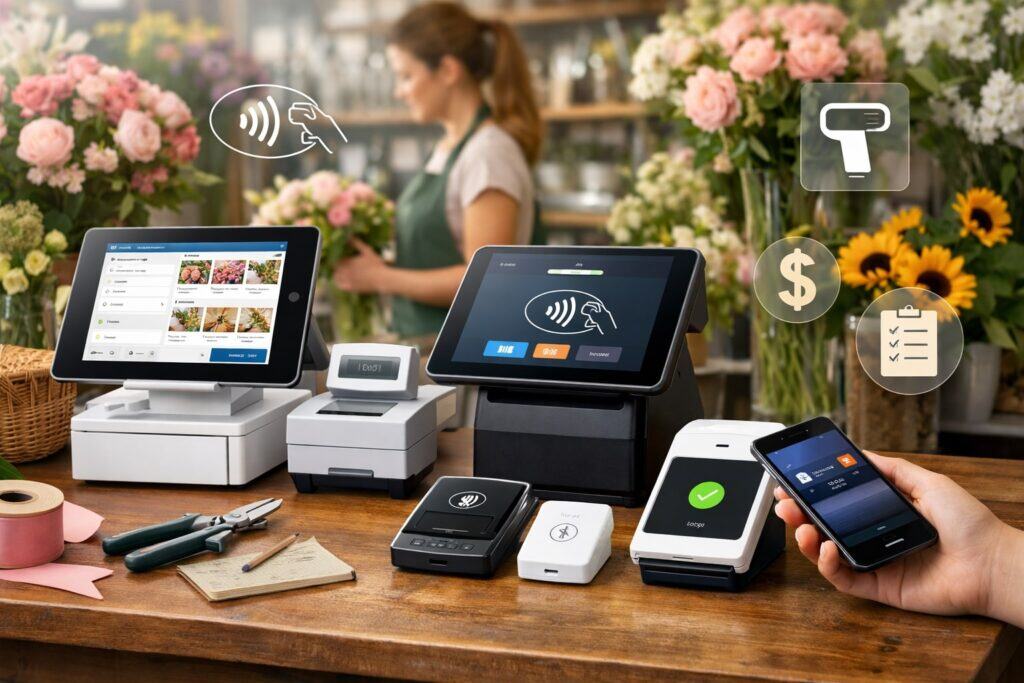
The POS you choose is the operational core of credit card processing for flower shops. It’s not just about accepting cards; it’s about managing product variants, add-ons, delivery fees, card-on-file for repeat customers, employee permissions, discounts, and tax handling.
Florists also need flexible item naming and custom notes (ribbon color, vase type, message card wording), which becomes vital for dispute evidence later.
Your hardware options include countertop terminals, tablet-based POS kits, handheld devices, and “softPOS” solutions that turn a phone into a terminal for contactless payments. For busy holidays, speed matters: you want fast checkout, minimal tapping on screens, and stable connectivity.
Also consider what happens when your internet goes down—offline mode can keep credit card processing for flower shops moving, but it needs careful configuration to avoid later declines.
You should also plan for mobility. Many florists sell at pop-ups, wedding venues, farmers markets, or partner locations. A mobile POS with stable cellular capability protects sales you’d otherwise lose. And if your shop handles delivery drivers in-house, having a compact device for payments on delivery (or for signature capture) can reduce disputes.
Finally, integration matters. A florist POS that syncs inventory, customer profiles, and online ordering into the same platform can reduce errors. Errors become chargebacks when customers see mismatches. Reliable credit card processing for flower shops depends on clean workflows, not just card acceptance.
Florist POS Integrations, Inventory, and Order Management
In a flower shop, the “product” is often semi-custom. That makes inventory and fulfillment tricky. A good florist POS does more than ring up sales; it supports item modifiers, delivery windows, substitutes, and order notes.
When this connects directly to credit card processing for flower shops, you get fewer payment mistakes and a better customer experience.
Look for POS features that matter specifically to florists:
- Customer profiles with delivery addresses and preferences
- Scheduled orders (future delivery dates, pickup times)
- Bundled products (bouquet + chocolate + balloon)
- Add-on prompts at checkout (upsells that increase ticket size)
- Partial payments and deposits for events
- Easy reprints of receipts and order confirmations
These features are not “nice to have.” They are operational defenses. Many disputes are not fraud—they’re confusion: wrong delivery date, missing add-on, or misunderstanding about substitution policy. If your system documents what the customer agreed to, credit card processing for flower shops becomes less risky.
Inventory integration also prevents overselling. If your website accepts orders for an out-of-stock item and you later substitute, you may trigger complaints and refunds. A connected POS reduces that gap by keeping online availability aligned with real stock.
The net effect is fewer refund requests, fewer chargebacks, and a cleaner payment history—important for maintaining favorable processing terms.
Mobile Payments, Delivery Acceptance, and Tap-to-Pay Options
Mobility is increasingly central to credit card processing for flower shops. Customers expect quick tap payments, and shop owners want flexible ways to accept cards without buying multiple terminals.
Tap-to-pay technology is a major trend. Apple’s Tap to Pay on iPhone allows merchants to accept contactless payments using an iPhone and a supported payment app—no separate terminal required. This matters for flower shops because it can reduce hardware costs and support pop-ups, curbside, and on-the-go acceptance.
More broadly, SoftPOS and tap-to-pay adoption is being pushed as a mainstream expectation in the near term. Industry messaging from payments hardware providers emphasizes that merchants should be prepared to accept tap payments as consumer behavior shifts.
For credit card processing for flower shops, the practical takeaway is: plan for contactless everywhere—countertop, handheld, and mobile.
For deliveries, you have two common strategies: prepay online/phone, or pay at delivery. Prepay reduces driver complexity but increases fraud exposure. Pay-at-delivery can reduce some fraud but introduces operational friction.
Many florists settle on “prepay unless corporate account / approved customer,” combined with delivery photo proof and recipient confirmation.
Whichever you choose, mobile acceptance should be secure and trackable. You want receipts that clearly state delivery terms, and ideally capture signature or confirmation when required. Done right, mobile tools make credit card processing for flower shops more flexible without increasing disputes.
Ecommerce, Phone Orders, and Recurring Billing for Flower Subscriptions
Online ordering and phone payments can grow revenue, but they also change the risk profile of credit card processing for flower shops. Card-not-present transactions carry higher fraud and are more likely to generate disputes—especially when the purchase is a gift delivered to someone else.
For ecommerce, the checkout experience must be fast and clear. Flower buyers are often in a hurry: birthdays, apologies, congratulations, sympathy arrangements. If your checkout is slow or confusing, you lose the sale.
If your checkout is too “loose” (no validation), you may accept fraudulent orders. Strong credit card processing for flower shops finds the middle ground: smooth checkout with enough verification to stop obvious fraud.
Phone orders create their own complexity. Staff are under pressure, and it’s easy to miskey numbers or skip address verification. If you take phone payments, your processor should support secure virtual terminal entry, address verification (AVS), and CVV prompts. You should also train staff on scripts: confirm delivery date, recipient details, substitution policy, and refund policy—then document it.
Recurring billing is another growth lane: weekly arrangements for offices, monthly subscriptions, or standing sympathy deliveries for funeral homes. Recurring revenue is powerful, but it requires card-on-file security and clear cancellation rules.
The best platforms for credit card processing for flower shops use tokenization so you’re not storing card numbers directly, reducing your risk and simplifying compliance.
Online Checkout, Fraud Filters, and Customer Experience
Your online checkout is where credit card processing for flower shops meets customer psychology. People buying flowers often care about timing and presentation more than price. That means they’ll abandon checkout if they don’t trust the site, can’t choose a delivery window, or don’t understand what happens if a specific flower is unavailable.
From a payments perspective, focus on these friction points:
- Clear delivery fees and delivery areas
- Delivery date/time slot selection
- Substitute policy and disclosure (seasonal availability changes)
- Gift message confirmation and preview
- Prominent order confirmation emails/texts
Fraud controls should be layered without making good customers suffer. Use AVS and CVV, block repeated attempts, set velocity limits for high-risk patterns, and consider manual review for unusual orders (large ticket, same-day delivery, new customer, mismatch addresses).
Many processors and gateways support basic rules; advanced setups may include device fingerprinting or 3-D Secure, depending on your platform and risk appetite.
For credit card processing for flower shops, you should also reduce “friendly fraud” by preventing misunderstandings.
The best defense is clarity: display your business name clearly on receipts, keep descriptors recognizable, send confirmation messages, and provide easy customer service contact info. A customer who can quickly resolve an issue with you is less likely to file a dispute with their bank.
Subscriptions, Invoicing, and Card-on-File Billing
Subscriptions can stabilize a floral business, and they can make credit card processing for flower shops more predictable.
Examples include: weekly desk arrangements for offices, monthly home subscriptions, or seasonal packages for loyal customers. Invoicing also matters for weddings and corporate accounts, where a deposit and milestone payments are common.
To run subscriptions safely, you need two things: secure card-on-file storage and clear customer authorization. Modern processors store cards as tokens, meaning your system keeps a reference, not the actual card number.
That reduces your risk exposure and supports smoother recurring billing. It also makes cancellation and reattempt logic easier when a card expires.
For invoices and events, avoid “handshake payments.” Use written agreements and send invoice links that capture customer details, order description, dates, and policies. If a dispute happens, documentation wins.
Strong credit card processing for flower shops includes tools that attach receipts, itemization, and customer acknowledgements.
Be especially careful with deposits. Customers may dispute a deposit if they believe it was refundable. Make the deposit policy explicit. Include it in the invoice and email confirmation.
If you use partial captures or delayed capture, ensure your POS/virtual terminal workflows match your policy—because technical mismatches can trigger customer confusion and chargebacks.
When done well, subscriptions and invoices transform credit card processing for flower shops from a cost center into a growth engine—because you’re not just taking payments, you’re building predictable revenue.
Security, PCI DSS 4.x Compliance, and Data Privacy
Security isn’t optional in credit card processing for flower shops—even for small shops. Any business that accepts card payments has responsibilities under PCI DSS. The standard has been evolving, and PCI DSS v4.x introduces changes and future-dated requirements that become mandatory after March 31, 2025.
The most important principle: reduce your scope. If your flower shop does not store card numbers, and you use validated payment terminals, hosted checkout pages, or tokenized card-on-file solutions, your PCI burden is typically lighter.
If you store card numbers in spreadsheets, email, or written notes, you dramatically increase risk and likely violate requirements. For credit card processing for flower shops, the safest operational rule is: never write down full card data, never store it yourself, and never request it over insecure channels.
PCI DSS v4.x emphasizes stronger authentication, better testing and monitoring, and more robust security practices across environments that touch card data. Many requirements are “best practice” during transition windows, but after March 31, 2025, future-dated requirements become mandatory.
This matters because compliance programs and scanning vendors may change what they require from you, and noncompliance can lead to monthly fees, increased scrutiny, or higher risk flags.
Data privacy also matters beyond PCI. Even if you don’t store card data, you do store customer names, phone numbers, addresses, and gift messages—sensitive information. Good credit card processing for flower shops includes access controls (who can see customer details), secure password practices, and vendor management. Your payments vendor is part of your security posture.
PCI DSS v4.x Timelines and What Flower Shops Should Do Now
PCI DSS v3.2.1 retired on March 31, 2024, and PCI DSS v4.0.1 became the active standard, according to PCI SSC updates. PCI SSC has also highlighted that organizations should adopt future-dated requirements, which come into effect on 31 March 2025.
After that date, future-dated requirements are no longer optional best practices—they are part of compliance expectations during assessments.
So what does a flower shop actually do with that information?
Start with practical actions that reduce risk immediately:
- Use PCI-validated hardware and hosted payment pages whenever possible.
- Eliminate manual storage: no card numbers in notebooks, email, or spreadsheets.
- Lock down access: staff logins, least-privilege permissions, and MFA where your vendors support it.
- Patch and update: POS devices, tablets, routers, and computers used for the business.
- Work with your processor’s PCI program to complete the correct SAQ (self-assessment questionnaire) and any required scans.
For credit card processing for flower shops, the goal is to keep your card data environment tiny. The smaller your environment, the easier it is to meet evolving requirements. That makes v4.x updates less disruptive.
Also plan for vendor conversations. Ask your POS and processor how they support PCI DSS v4.0.1, what changes they require from merchants after March 31, 2025, and what documentation you should keep.
You don’t need to become a security engineer—but you do need a payment stack that keeps you compliant by design.
Tokenization, Encryption, and Incident Response Basics
The most effective security move in credit card processing for flower shops is tokenization: letting your processor store card data securely while your system stores only a token.
Tokenization supports recurring billing and repeat customers without exposing you to full card numbers. It also makes refunds and reorders simpler, which matters during peak seasons.
Encryption protects card data in transit and at rest. Modern terminals and gateways use encryption so card data is protected between the device and processor.
Your job is to avoid breaking the chain—by not copying card details into unsafe channels. That means no “text me your card number,” no emailing card details, and no storing it “just temporarily.” Those shortcuts can create serious exposure.
Incident response may sound dramatic, but every flower shop should have a basic plan. If you suspect compromise—strange POS behavior, unexpected software installs, customer complaints about fraud—contact your processor, your POS vendor, and your IT support immediately.
Rotate passwords, isolate affected devices, and document what happened. PCI programs often require prompt response and evidence of remediation.
Security also includes fraud prevention settings: AVS/CVV prompts for keyed entry, user permissions, and audit logs. Strong credit card processing for flower shops combines these technical protections with staff training, because most real-world issues come from mistakes under pressure.
Chargebacks, Refunds, and Disputes in Floral Sales
Disputes are one of the biggest hidden costs in credit card processing for flower shops. Chargebacks don’t just refund the sale; they add fees, consume staff time, and can harm your processing profile if they become frequent.
Flower shops see unique dispute patterns:
- “Goods not received” (delivery disputes)
- “Not as described” (expectations vs. reality)
- “Canceled order” disagreements
- Friendly fraud (buyer recognizes charge late, or disputes to avoid paying)
- True fraud (stolen card used for delivery)
The key to reducing disputes is to separate the issues you can prevent from the issues you can only document. You can prevent many disputes by improving clarity: show delivery dates, substitution policy, and what’s included in photos. You can’t prevent every complaint, but you can win many disputes with evidence.
Refund policy design also matters. Florals are perishable. If your policy is too strict, customers jump straight to chargebacks. If your policy is too loose, you lose margin. Strong credit card processing for flower shops includes a “customer rescue” workflow: resolve quickly, document outcomes, and keep communication records.
Also, train staff to avoid reactive refunds without documentation. Inconsistent refunds create patterns that banks may interpret as merchant risk. Having a standard process helps you stay professional and makes disputes less chaotic.
Common Chargeback Reasons for Flower Shops and Prevention Steps
The best way to lower chargebacks in credit card processing for flower shops is to target the top causes with specific fixes.
- Delivery disputes: Use delivery photo proof, timestamped notes, and recipient confirmation when possible. If you deliver to offices or hospitals, document reception desk name. Send “delivered” notifications to the purchaser.
- Not as described: Display clear product photos, but also disclose that arrangements vary based on seasonal availability. Make substitution policy explicit at checkout and in confirmation emails.
- Duplicate charges: Train staff on what to do when a terminal errors out. Duplicate attempts during busy times can create double charges. Your POS should help identify duplicates quickly.
- Canceled order confusion: Require cancellation windows for same-day delivery. Capture customer acceptance of that policy before charging, especially on phone orders.
- Fraud: Use AVS/CVV, block mismatched signals, and set manual review for unusually high-risk orders. If an order seems suspicious, call the customer using a verified number (not the one provided in the order) or request alternate verification.
Every one of these measures improves credit card processing for flower shops not by changing your fees, but by reducing “loss events.” Over time, fewer disputes also improves your standing with processors and may help you qualify for better terms.
Winning Disputes: Evidence, Representment, and Documentation
When a chargeback happens, your success depends on evidence. For credit card processing for flower shops, your evidence package should be standardized so staff can assemble it quickly.
Strong evidence often includes:
- Order confirmation showing date, amount, and item description
- Customer communication logs (email/text confirmation, delivery notices)
- Proof of delivery (photo, signature, GPS timestamp, recipient name)
- Policy disclosures (substitution policy, cancellation policy)
- Invoice or contract for event work (weddings/corporate)
- Refund history and notes (if any attempt was made to resolve)
Representment is the process of responding to the chargeback through your processor. Timelines can be short, so you need a system that stores documents in one place. Many POS platforms and payment gateways can attach notes and receipts automatically.
That’s a major advantage for credit card processing for flower shops because disputes tend to arrive weeks later, long after the holiday rush.
Also, be careful with how your business name appears on statements. If your descriptor is confusing, customers may dispute. Ask your processor to help optimize your statement descriptor so it’s recognizable.
Dispute prevention is best, but dispute management is unavoidable. Treat it like a process, not an emergency. That mindset is one of the biggest upgrades a florist can make to credit card processing for flower shops.
Managing Costs: Interchange, Tips, Surcharging, and Cash Discounting
Cost control is the daily reality of credit card processing for flower shops. Flowers are perishable, margins can be tight, and pricing competition is real. Processing costs can be optimized, but only if you focus on the right levers.
First, improve your acceptance mix: encourage tap and chip over swipe where possible, because modern acceptance methods reduce certain fraud risk and align with mainstream consumer behavior. Second, reduce keyed entries.
If you take phone orders, consider sending a secure payment link instead of keying card numbers. That can lower risk and sometimes improve effective costs depending on the payment method used.
Batching also matters. If you don’t close batches consistently, you may incur higher costs or delays. Set an automatic daily batch close, especially during holiday weeks.
Also monitor downgrades: certain business cards and keyed transactions may carry higher costs. The “fix” is usually operational: use the right fields, capture the right details, and keep transactions in the best category your system supports.
Surcharging and cash discounting are often discussed as ways to offset fees, but they must be done carefully. Visa provides detailed guidance for merchant surcharging, including notice requirements and disclosure expectations.
Mastercard also caps surcharges and requires disclosures and advance notice. If you choose these strategies, compliance and customer experience must come first.
Practical Cost-Levers Flower Shops Can Use Immediately
Before you change pricing or add a surcharge, start with safer levers that improve credit card processing for flower shops without customer friction.
- Shift phone orders to pay-by-link: Customers enter card details themselves, reducing keying errors and exposure.
- Adopt contactless everywhere: Faster checkout reduces lines and improves throughput during peak periods.
- Reduce refunds through clarity: Clear policies and confirmation messages reduce misunderstandings.
- Audit monthly statements: Watch for PCI fees, gateway fees, and unexpected add-ons.
- Use one integrated stack: Fewer disconnected tools means fewer reconciliation mistakes.
Also, negotiate from data. Your processor can’t guess your real transaction mix. Pull a monthly report showing card-present vs card-not-present, average ticket, refund rate, and chargeback rate. Then ask for pricing adjustments aligned with your actual profile.
For credit card processing for flower shops, the most sustainable savings usually come from (a) reducing card-not-present losses and (b) lowering processor markup and junk fees—more than trying to “hack” interchange. Interchange is largely pass-through. Your operational choices and provider relationship are where you win.
Finally, remember that reliability is part of cost. A cheaper provider that fails on Valentine’s Day is expensive. Choose a setup that can scale under pressure.
Surcharging and Cash Discounting Rules Florists Must Understand
Many flower shops explore surcharging or cash discounting to offset rising acceptance costs. These strategies can work, but they require strict compliance and careful customer communication—especially in credit card processing for flower shops, where purchases are often emotional and time-sensitive.
Visa’s guidance indicates surcharging is limited to credit transactions and includes requirements such as notifying your acquirer in advance and clearly disclosing surcharges at the point of entry and on receipts; Visa also describes limits tied to merchant cost and a cap described in their materials.
Mastercard’s rules similarly cap surcharge amounts relative to the merchant’s cost and require advance notice plus disclosure on receipts and at point of sale.
Cash discounting is different: you post a “regular price,” then offer a discount for paying with cash (or another method). Networks typically treat this differently than a surcharge, but execution still matters—signage, receipts, and consistent application. If you do it poorly, you risk consumer complaints and compliance issues.
For credit card processing for flower shops, the customer experience risk is real. Someone buying sympathy flowers may react negatively to unexpected checkout fees. If you implement a surcharge, be transparent: signage at entry, clear language online before checkout, and clear receipts.
If you want the simplest path, start with operational cost controls first. Then, if needed, explore compliant pricing strategies with your processor and, where appropriate, legal counsel—because rules can vary and change.
Operational Best Practices for Peak Seasons
Peak seasons stress-test credit card processing for flower shops. It’s not just volume—it’s speed, staffing changes, delivery complexity, and customer urgency. The most profitable florists treat peak season payments as a planned system, not a scramble.
Start with capacity planning. Ensure you have enough payment stations (or mobile devices), enough receipt paper if needed, and a backup internet plan. If your POS supports offline mode, understand the risk: offline transactions may later decline, so use offline acceptance only when necessary and set transaction limits.
Then simplify checkout workflows. Create fast buttons for best-sellers, pre-build bundles, and add-on prompts. Train seasonal staff on the “payment script” to prevent disputes: confirm delivery date, address, substitution policy, and contact info. The goal is fewer order errors that turn into refunds and chargebacks later.
Also, consider pre-orders. The earlier you capture demand, the smoother your day-of volume. Offer scheduled pickup windows, delivery slot selection, and simple add-ons. The smoother the ordering experience, the smoother credit card processing for flower shops becomes under pressure.
Finally, keep a close eye on declines. During peak days, even a small increase in decline rates can cost thousands. Declines can come from fraud controls set too strictly, connectivity issues, or staff errors. Monitor in real time, and have a fallback: payment links, alternate terminals, or a backup device.
Speed, Staffing, and Throughput at the Register
If your line gets long, you lose sales. Peak operations require checkout speed, and that’s a direct function of credit card processing for flower shops.
Start with contactless readiness. When customers can tap quickly, throughput increases. If your system makes staff navigate multiple screens, build a “holiday mode” menu: top items, fast modifiers, and minimal prompts. You can still capture necessary delivery details—but do it efficiently.
Staffing is equally important. Seasonal staff should be trained specifically on payment handling: how to avoid duplicate charges, what to do when a transaction times out, how to confirm order details, and how to print or text receipts. Duplicate charges are common during panic moments, and they create angry customers and disputes.
Also set permissions. Not every staff member should be able to issue large refunds or change pricing. Proper permissions protect your business from errors and internal misuse—both of which can damage your payments profile.
For credit card processing for flower shops, speed must not sacrifice accuracy. A mis-entered delivery address costs more than a slow checkout. The best systems support both speed and structured data capture.
Pre-Orders, Deposits, and Managing High-Ticket Event Payments
High-ticket orders—weddings, corporate events, large sympathy tributes—are where credit card processing for flower shops can either shine or cause problems.
Pre-orders reduce chaos, but you need the right payment flow. For events, deposits are common. Make sure your invoice clearly describes: what the deposit covers, when remaining balances are due, what happens in case of changes, and your cancellation policy. Then keep customer acknowledgements. The more explicit you are, the fewer disputes arise later.
Also consider how you capture funds. Some shops authorize and capture later; others charge deposits immediately. Delayed capture can fail if the card changes or the authorization expires. Charging deposits reduces that risk but requires clear policy disclosures to avoid disputes.
For corporate accounts, you may have repeat invoices and multiple delivery addresses. Card-on-file via tokenization helps, but you must manage authorization: who is allowed to approve charges, what limits exist, and how receipts are sent. A clean workflow prevents internal confusion at the customer’s organization.
Finally, large payments can trigger processor risk holds if your typical volume is smaller. Proactively tell your processor about the event season, keep contracts on file, and use invoicing tools that clearly document delivery dates and services. That reduces surprises and makes credit card processing for flower shops more stable when you most need it.
Future Trends and Predictions for Flower Shop Payments
Payments are changing quickly, and credit card processing for flower shops will keep evolving with consumer habits, security requirements, and fee pressure.
First, contactless and wallet payments will keep growing, and merchants will be expected to accept them easily across devices.
Tap-to-pay on phones reduces the need for dedicated terminals and can expand acceptance into pop-ups and delivery contexts. Apple continues to position Tap to Pay on iPhone as a mainstream acceptance method for merchants using supported apps.
Second, security expectations will continue to rise. PCI DSS v4.0.1 and the mandatory future-dated requirements after March 31, 2025 point toward stronger authentication, better monitoring, and improved security hygiene becoming standard even for smaller merchants.
For florists, that means your vendors’ security capabilities will matter more, and “old POS on an old router” will become increasingly risky and expensive.
Third, merchant fee pressure is a real story. A recent Reuters report described continued legal and industry conflict around card fees, including objections from major retailers to a proposed settlement involving Visa and Mastercard swipe fees.
While flower shops aren’t litigating fee structures, fee trends and rules changes can flow downstream over time.
The safest future-proofing move is to choose a flexible payments stack: modern acceptance methods, tokenization, strong reporting, and clear contract terms. That way, credit card processing for flower shops stays resilient even as the ecosystem changes.
The Rise of SoftPOS, Contactless Expectations, and Faster Checkout
SoftPOS—turning smartphones into payment acceptance devices—is one of the most practical future shifts for credit card processing for flower shops. It’s not about replacing every terminal overnight; it’s about adding flexible “extra registers” when you need them.
Tap-to-pay options are already positioned as simple: open the payment app, enter the amount, and accept contactless payment with a phone. For flower shops, that can mean a holiday pop-up station, a curbside pickup lane, or a quick checkout point near pre-made bundles.
Consumer expectation is also moving toward contactless. People want quick, hygienic, and familiar payment experiences. Payments providers are signaling that merchants should be ready for tap-to-pay behavior as it becomes dominant.
In practical terms, flower shops that don’t offer tap may start to feel outdated, and slower checkout can cost sales during peak days.
The operational win is throughput. Faster checkout means fewer abandoned purchases, less staff stress, and fewer transaction errors. Fewer errors means fewer disputes—which directly improves credit card processing for flower shops.
Expect more POS systems to bundle softPOS as an add-on. The winners will be shops that implement it thoughtfully: stable connectivity, staff training, and clear receipt delivery (text/email) so customers trust the transaction.
Fee Pressure, Rule Changes, and What They Could Mean for Small Merchants
Flower shops can’t control industry-wide fee structures, but you can anticipate how the environment may influence credit card processing for flower shops.
Public debate around swipe fees continues. Reuters recently reported objections from large retailers and trade groups to a proposed settlement involving Visa and Mastercard, arguing the fee reductions were minimal and the rules still constrained merchants. Even if outcomes shift, the broader pattern is clear: merchant fees remain a contested topic.
What should a florist do with that information? Focus on controllables:
- Use modern acceptance methods to reduce avoidable risk and inefficiency.
- Keep chargebacks low (your “risk profile” influences your options).
- Negotiate processor markup and eliminate unnecessary monthly fees.
- Keep your contract flexible so you can switch if terms become uncompetitive.
Also watch for policy shifts around surcharging and disclosures. Network rules already require specific notices, disclosures, and caps for surcharging programs. If fee pressures rise, more merchants consider surcharging—but compliance enforcement can also increase.
The likely future is more transparency and more compliance expectations. Shops that treat credit card processing for flower shops as a managed system—not an afterthought—will stay profitable even as fee dynamics evolve.
FAQs
Q.1: What is the best setup for a small flower shop just starting out?
Answer: For a new shop, the best credit card processing for flower shops setup is usually the one that minimizes complexity while protecting you from fraud and compliance headaches.
That typically means a modern POS with built-in card acceptance, contactless-capable hardware, and a simple pricing plan you can understand. Early on, predictability matters more than shaving tiny percentages off your rate—especially when sales volume fluctuates.
You should prioritize reliability and support. A new shop can’t afford downtime during busy weekends. Choose a provider that offers stable deposits, clear reporting, and a straightforward refund workflow.
Also make sure you can accept online payments early, even if your website is simple. Many florists generate meaningful revenue from delivery orders and gift purchases, which depend on smooth card-not-present acceptance.
Security-wise, avoid storing card numbers yourself. Use payment links, hosted checkout, and tokenized card-on-file tools when needed. PCI expectations evolve over time, and future-dated requirements in PCI DSS v4.x become mandatory after March 31, 2025, so starting with a modern, compliant stack is the easiest long-term move.
Q.2: Why do phone and online flower orders get flagged as higher risk?
Answer: Phone and online orders are card-not-present, meaning the card isn’t physically read by a chip or tap device. That raises fraud risk, and it changes how credit card processing for flower shops is priced and monitored.
Fraudsters like delivery businesses because products are quickly fulfilled and hard to recover, and because the buyer and recipient are often different people.
In practical terms, card-not-present transactions have fewer built-in authentication signals than card-present transactions. That’s why processors rely more on AVS (address verification), CVV checks, device signals, and behavior patterns.
When those signals don’t match—or when an order looks unusual (large ticket, rushed delivery, mismatch addresses)—the transaction may be declined or held for review.
Florists can reduce this risk by tightening checkout verification, using payment links for phone orders instead of manual keying, and documenting delivery confirmation. This is not about making life harder for real customers; it’s about making credit card processing for flower shops resilient to the kinds of fraud patterns that target delivery-based merchants.
If you treat card-not-present as a unique workflow with its own safeguards, you’ll see fewer declines, fewer chargebacks, and a healthier processing relationship over time.
Q.3: Should a flower shop add a surcharge to credit card transactions?
Answer: A surcharge can offset costs, but it’s not automatically the best move for credit card processing for flower shops. Florals are emotional purchases, and customers often buy under time pressure. If a surcharge shows up late in checkout, customers may feel surprised or upset, which can lead to abandoned purchases or disputes.
If you do surcharge, you must follow card network rules and applicable laws. Visa’s guidance includes requirements such as notifying your acquirer in advance, limiting surcharges to credit (not debit/prepaid), and clearly disclosing the surcharge at appropriate points and on receipts. Mastercard also requires advance notice and caps surcharges relative to merchant cost, with clear disclosure.
Many florists find better results by first improving operations: shifting phone orders to payment links, increasing contactless acceptance, reviewing fees, and reducing chargebacks. Those changes improve credit card processing for flower shops without changing your pricing to customers.
If your margins are still too tight, a carefully implemented cash discount or compliant surcharge program may help—just make transparency your first priority.
Q.4: How can I lower my processing fees without hurting checkout conversion?
Answer: Lowering costs while keeping checkout smooth is the sweet spot of credit card processing for flower shops. Start with “invisible” improvements that customers won’t notice:
- Encourage tap/chip in-store for speed and reliability.
- Use payment links for phone orders to reduce keying mistakes.
- Batch daily and keep your system updated.
- Audit statements for avoidable monthly fees.
- Reduce refunds and disputes through clearer policies.
Then review your pricing model. If you’ve grown beyond a small startup, interchange-plus pricing may reduce your effective rate compared with flat-rate—depending on your transaction mix. If you’re heavily delivery-driven, invest in fraud controls first; fraud losses and chargeback fees often dwarf small rate differences.
Also, optimize customer experience. Confusing checkout causes abandoned carts, and abandoned carts increase “marketing cost per sale.” Better checkout can indirectly improve profitability more than micro-optimizing rates.
Finally, work with a provider that understands seasonality. You want credit card processing for flower shops that doesn’t punish you with funding holds just because you’re busy during holidays.
Q.5: What does PCI compliance actually mean for a flower shop?
Answer: PCI compliance is a set of security requirements for any business that accepts card payments. For credit card processing for flower shops, the practical meaning is: protect payment data and follow the validation steps required for your setup (often a self-assessment questionnaire and, in some cases, scans).
The easiest path is to reduce your PCI scope by using validated terminals and hosted payment tools so you’re not storing or transmitting card data yourself. If you avoid storing card numbers and you keep your systems updated, your compliance burden is usually manageable.
PCI DSS v4.x continues to evolve, and PCI SSC has indicated future-dated requirements become effective on 31 March 2025. PCI DSS v4.0.1 is published and supported as the active standard, with v3.2.1 having retired earlier.
This doesn’t mean a small florist must implement enterprise-level security overnight, but it does mean your vendors and your PCI program may ask more of you over time.
The best approach for credit card processing for flower shops is to choose a modern payment stack that is designed for compliance and to complete your annual PCI validation steps on schedule.
Q.6: What payment trends should flower shops prepare for in the next few years?
Answer: Several trends are shaping the future of credit card processing for flower shops. First is the continued dominance of contactless and mobile wallets. Customers expect fast tap payments, and merchant tools are adapting to make acceptance cheaper and more flexible.
Tap-to-pay on smartphones is a notable shift. Apple markets Tap to Pay on iPhone as a way to accept contactless payments using an iPhone and a supported app, without extra hardware. This can give florists more mobility for pop-ups, curbside, and seasonal overflow lanes.
Second is increased security expectations. PCI DSS v4.x future-dated requirements becoming mandatory after March 31, 2025 is part of a broader trend toward stronger security practices becoming standard for all merchants.
Third is ongoing merchant fee pressure and rule scrutiny. Public reporting continues to highlight tension around card acceptance costs and rules. While outcomes can vary, the practical prediction is that florists will benefit from flexibility: contracts that are easy to renegotiate, payment stacks that support modern methods, and processes that keep disputes low.
The flower shops that treat credit card processing for flower shops as an evolving system—not a one-time setup—will stay ahead.
Conclusion
The best credit card processing for flower shops is not just a rate—it’s a complete, reliable workflow that fits how florists actually sell: fast in-store checkout, delivery orders, phone payments, event invoices, and seasonal surges. When your system supports those realities, you get fewer declines, faster lines, cleaner reporting, and fewer disputes.
To win with credit card processing for flower shops, focus on the fundamentals: choose a pricing model that matches your transaction mix, use modern contactless-capable acceptance (including mobile options when needed), reduce card-not-present risk with smart verification and clear policies, and keep security and PCI compliance as a built-in habit—especially as PCI DSS v4.x requirements mature beyond March 31, 2025.